Download FREE Sample


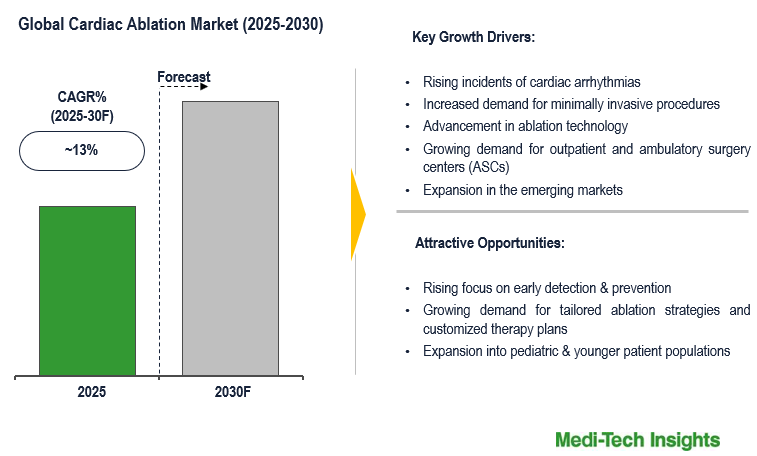
The cardiac ablation market is projected to grow at a CAGR of ~13% over the forecast period. Major factors driving growth include rising incidents of cardiac arrhythmias, increased demand for minimally invasive procedures, advancement in ablation technology, growing demand for outpatient and ambulatory surgery centers (ASCs), and expansion in emerging markets.
Cardiac ablation, or catheter ablation, is a minimally invasive procedure that uses heat or cold energy to create small scars in the heart. These scars help block abnormal electrical signals, preventing or stopping irregular heartbeats, known as arrhythmias, and restoring a normal rhythm. Arrhythmias occur when the heart-s electrical signals malfunction, causing it to beat too fast, too slow, or irregularly. The procedure typically uses thin, flexible catheters inserted through a blood vessel. In some cases, ablation may also be performed during heart surgery.
To learn more about the research report, download a sample report.
Technological innovations driving the growth of cardiac ablation technology
Cardiac ablation technology holds great potential in healthcare, with its minimally invasive technique being significant for a range of cardiovascular diseases, including atrial fibrillation, atrial flutter, supraventricular tachycardia (SVT), and arrhythmias. Recent advancements in cardiac ablation technology cover a range of different areas, including:
- Improved Imaging: Recent advancements in cardiac imaging have significantly enhanced the efficacy and safety of atrial fibrillation ablation. Pre-procedural imaging plays a crucial role in identifying anatomical variations, while the use of transesophageal echocardiography (TEE) and intracardiac echocardiography (ICE) has become standard practice during procedures. These imaging techniques help minimize transseptal puncturated complications, leading to improved procedural outcomes and patient safety
- Improved Cryoablation Technologies: Cryoballoon ablation has emerged as a highly effective alternative for atrial fibrillation (AF) treatment, utilizing extreme cold to achieve pulmonary vein isolation and significantly reduce AF burden. Its proven efficacy makes it a leading choice for AF management
- Pulsed Field Ablation for Atrial Fibrillation: Pulsed-field ablation (PFA) is emerging as one of the most promising new technologies in cardiac ablation. This non-thermal technique induces irreversible micropores in cell membranes, leading to targeted cell death. Previously utilized for treating solid tumors in cancer therapy, PFA shows significant potential as a uniquely safe and effective modality for atrial fibrillation (AF) ablation. Its key advantage lies in its ability to minimize collateral tissue damage, as cardiomyocytes have the lowest threshold for pulsed electric fields, ensuring precise and selective ablation.
- Radiofrequency (RF) Ablation: Traditional radiofrequency (RF) ablation relies on heat to create lesions, but the newer high-power, short-duration RF ablation (50W-90W) delivers energy more rapidly and precisely. This technique shortens procedure time while maintaining effectiveness and reduces the risk of complications such as char formation and steam pops.
To learn more about the research report, download a sample report.
Rising incidents of cardiac arrhythmias drive market growth
The prevalence of cardiac arrhythmias is rising globally, driven by factors such as the aging population, increasing rates of cardiovascular diseases, and lifestyle changes. Atrial fibrillation (AFib), the most common arrhythmia, affects approximately 59 million people worldwide, as per the Global Burden of Disease (GBD) 2019 study with cases expected to rise significantly due to risk factors like hypertension, obesity, diabetes, and sedentary lifestyles. Additionally, life-threatening arrhythmias such as ventricular tachycardia (VT) and supraventricular tachycardia (SVT) are becoming more common, contributing to higher rates of stroke, heart failure, and sudden cardiac death (SCD). Advances in diagnostic technologies, including wearable ECG devices and AI-driven monitoring, are improving early detection, leading to higher reported cases. Moreover, environmental factors such as air pollution, chronic stress, and excessive alcohol or stimulant consumption are also increasing arrhythmia incidence. As a result, the growing burden of arrhythmias is fueling demand for effective treatment options like catheter ablation, making electrophysiology a rapidly expanding field in cardiology.
Competitive Landscape Analysis
The global cardiac ablation market is marked by the presence of established and emerging market players such as Abbott Laboratories; Medtronic Plc; Johnson & Johnson; Boston Scientific Corporation; AtriCure Inc.; MicroPort Scientific Corporation; Acutus Medical, Inc.; BIOTRONIK; AngioDynamics; Olympus Corporation; CONMED Corporation; Ethicon Inc.; and Alcon; among others. Some of the key strategies adopted by market players include new product development, strategic partnerships and collaborations, and investments.
Report Scope
|
Report Scope |
Details |
|
Base Year Considered |
2024 |
|
Historical Data |
2023 - 2024 |
|
Forecast Period |
2025 - 2030 |
|
Growth Rate |
~13% |
|
Market Drivers |
|
|
Attractive Opportunities |
|
|
Segment Scope |
Technology, Application, and End User |
|
Regional Scope |
|
|
Key Companies Mapped |
Abbott Laboratories; Medtronic Plc; Johnson & Johnson; Boston Scientific Corporation; AtriCure Inc.; MicroPort Scientific Corporation; Acutus Medical, Inc.; BIOTRONIK; AngioDynamics; Olympus Corporation; CONMED Corporation; Ethicon Inc.; and Alcon |
|
Report Highlights |
Market Size & Forecast, Growth Drivers & Restraints, Trends, Competitive Analysis |
Market Segmentation
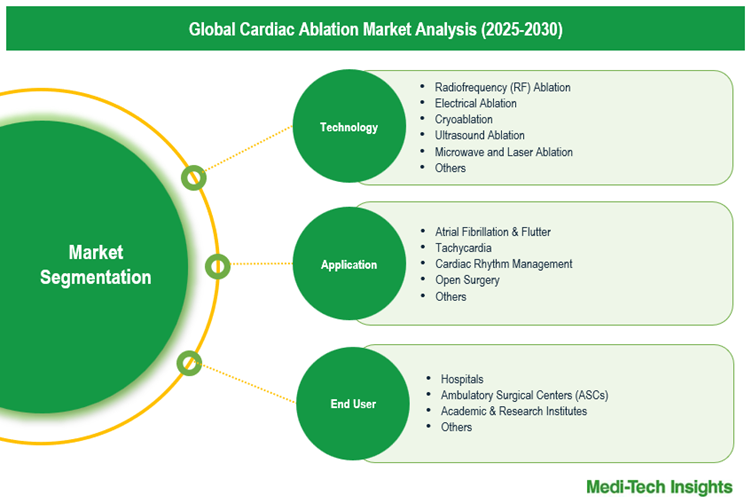
This report by Medi-Tech Insights provides the size of the global cardiac ablation market at the regional- and country-level from 2023 to 2030. The report further segments the market based on technology, application, and end user.
- Market Size & Forecast (2023-2030), By Technology, USD Million
- Radiofrequency (RF) Ablation
- Electrical Ablation
- Cryoablation
- Ultrasound Ablation
- Microwave and Laser Ablation
- Others
- Market Size & Forecast (2023-2030), By Application, USD Million
- Atrial fibrillation & flutter
- Tachycardia
- Cardiac Rhythm Management
- Open Surgery
- Others
- Market Size & Forecast (2023-2030), By End User, USD Million
- Hospitals
- Ambulatory Surgical Centers (ASCs)
- Academic & Research Institutes
- Others Market Size & Forecast (2023-2030), By Region, USD Million
- North America
- US
- Canada
- Europe
- UK
- Germany
- France
- Italy
- Spain
- Rest of Europe
- Asia Pacific
- China
- India
- Japan
- Rest of Asia Pacific
- Latin America
- Middle East & Africa
Need a More Tailored Analysis?
- Discuss the market sizing methodology and forecast assumptions with our healthcare analysts.
- Expand the scope with additional countries, market segments, technologies, or competitor profiling.
- Use the insights to support strategic planning, market entry, commercial due diligence, and long-term revenue growth initiatives.