Download FREE Sample


Cloud computing in healthcare refers to the use of remote servers hosted on the internet to store, manage, and process healthcare data and applications. It enables healthcare providers to access patient information, analytics, and software solutions anytime, anywhere, fostering seamless collaboration and data sharing. By leveraging scalable and flexible infrastructure, cloud computing reduces the need for costly on-premises systems, enhances operational efficiency, and supports innovations like telemedicine, artificial intelligence (AI), and big data analytics. It also facilitates the integration of electronic health records (EHRs), Internet of Things (IoT) devices, and remote monitoring solutions, improving patient care and healthcare delivery.

To learn more about this report, download the PDF brochure
Key player efforts for adoption of cloud computing through funding to propel market demand
In June 2024, Amazon Web Services (AWS) provided a $10 million grant to accelerate the adoption of cloud computing through strategic funding initiatives. By enabling cloud-based data sharing and AI-driven analysis, AWS supports faster diagnoses and personalized treatments for rare diseases, enhancing collaboration across institutions. Further in January 2024, AWS added $20 million in funding to its Health Equity Initiative, bringing the total to $60 million, aimed at using cloud-based technologies to improve healthcare access for underserved populations. By focusing on cloud-hosted solutions, AWS is driving the adoption of cloud computing in healthcare to address critical gaps such as equitable diagnostics, social determinants of health, and the impact of climate change on health.
Switching from legacy systems presents a significant challenge
Switching from legacy systems presents a significant challenge for the adoption of healthcare cloud computing market. While cloud solutions offer scalability, improved data management, and cost efficiency, transitioning from outdated systems involves complex integration, high costs, and substantial financial investment. The process requires extensive customization and data migration efforts, which can disrupt operations and lead to downtime. Additionally, healthcare staff must be trained to adapt to new cloud-based systems, potentially facing resistance and requiring time to adjust. Ensuring accurate and secure data migration is crucial, as any errors can affect patient care and compliance. Despite these challenges, overcoming them can lead to substantial long-term benefits, driving growth and innovation in the healthcare cloud computing sector.
Key players are focusing on inorganic growth strategies to establish their foothold in the market
Players operating in this market are adopting both organic and inorganic growth strategies. Inorganic growth strategies such as partnerships/collaborations are some of the key strategies adopted by market players to promote use cloud computing within healthcare and thereby enhance their presence. For instance,
- In September 2024, Nova Scotia Health partnered with Google Cloud to implement AI-driven solutions through cloud infrastructure. By leveraging Google Cloud-s advanced capabilities like natural language processing (NLP) and AI for healthcare, this partnership is expected to improve patient care, streamline administrative workflows, and enhance clinical decision-making
- In July 2024, GE Healthcare partnered with Amazon Web Services (AWS) to develop generative AI models aimed at enhancing healthcare operations, including data analysis, diagnostics, and workflow optimization. This collaboration leverages AWS-s cloud infrastructure, particularly Amazon Bedrock, to integrate advanced AI solutions, positioning it as a key effort in the cloud computing market for healthcare
- In Oct 2023, AWS collaborated with the Indian government to create digital health IDs and longitudinal health records, storing patient data on a centralized cloud platform. By integrating platforms like CoWIN and Arogya Setu with AWS cloud infrastructure, the initiative will streamline healthcare records and offer scalable, secure cloud-based solutions for managing health data from birth to end
To learn more about this report, download the PDF brochure
Competitive Landscape Analysis
The global cloud computing in healthcare market is marked by the presence of established and emerging market players such as Amazon Web Services, Inc., Microsoft, Google LLC, eClinicalWorks, CareCloud, Inc., IBM Corporation, Oracle, Veradigm LLC, Siemens Healthineers, and Koninklijke Philips N.V.; among others. Some of the key strategies adopted by market players include new product development, strategic partnerships and collaborations, and geographic expansion.
Report Scope
| Report Metric | Details |
| Base Year Considered | 2024 |
| Historical Data | 2023 - 2024 |
| Forecast Period | 2025 - 2030 |
| Growth Rate | 16% |
| Market Drivers |
|
| Attractive Opportunities |
|
| Segment Scope | Product, Component, Service Model, Pricing Model, End User |
| Regional Scope |
|
| Key Companies Mapped | Amazon Web Services, Inc., Microsoft, Google LLC, eClinicalWorks, CareCloud, Inc., IBM Corporation, Oracle, Veradigm LLC, Siemens Healthineers, and Koninklijke Philips N.V. among others |
| Report Highlights | Market Size & Forecast, Growth Drivers & Restraints, Trends, Competitive Analysis |
Global Cloud Computing in Healthcare Market Segmentation
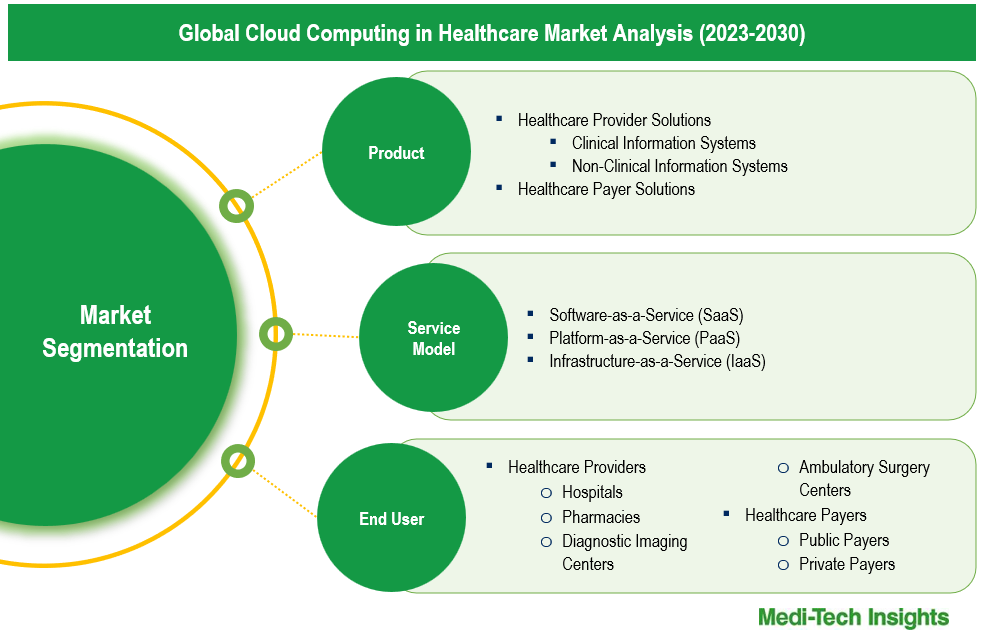
This report by Medi-Tech Insights provides the size of the global cloud computing in healthcare market at the regional- and country-level from 2023 to 2030. The report further segments the market based on product, component, service model, pricing model, and end user.
Market Size & Forecast (2023-2030), By Product, USD Million
- Healthcare Provider Solutions
- Clinical Information Systems
- Electronic Health Records (EHR/EMR)
- Picture Archiving and Communication Systems (PACS) & Vendor Neutral Archive (VNA)
- Population Health Management (PHM) Solutions
- Telehealth and Telemedicine Solutions
- Radiology Information Systems (RIS)
- Laboratory Information Systems (LIS)
- Pharmacy Information Systems
- Other Clinical Information Systems
- Non-Clinical Information Systems
- Revenue Cycle Management (RCM) Solutions
- Financial Management Solutions
- Health Information Exchange (HIE) Solutions
- Supply Chain Management Solutions
- Billing & Account Management Solutions
- Other Non-Clinical Information Systems
- Clinical Information Systems
- Healthcare Payer Solutions
- Claims management solutions
- Payment Management Solutions
- Customer Relationship Management Solutions
- Provider Network Management Solutions
- Fraud Management Solutions
- Other healthcare Payer Solutions
Market Size & Forecast (2023-2030), By Component, USD Million
- Software
- Services
Market Size & Forecast (2023-2030), By Deployment Model, USD Million
- Public Cloud
- Private Cloud
- Hybrid Cloud
Market Size & Forecast (2023-2030), By Service Model, USD Million
- Software-as-a-Service (SaaS)
- Platform-as-a-Service (PaaS)
- Infrastructure-as-a-Service (IaaS)
Market Size & Forecast (2023-2030), By Pricing Model, USD Million
- Pay-As-You-Go Pricing Model
- Subscription-Based Pricing Model
Market Size & Forecast (2023-2030), By End User, USD Million
- Healthcare Providers
- Hospitals
- Pharmacies
- Diagnostic Imaging Centers
- Ambulatory Surgery Centers
- Healthcare Payers
- Public Payers
- Private Payers
Market Size & Forecast (2023-2030), By Region, USD Million
- North America
- US
- Canada
- Europe
- UK
- Germany
- France
- Italy
- Spain
- Rest of Europe
- Asia Pacific
- China
- India
- Japan
- Rest of Asia Pacific
- Latin America
- Middle East & Africa
Frequently Asked Questions About This Report
What is the market size & forecast of the cloud computing in healthcare market?
What are historical, present, and forecasted market shares and growth rates of various segments and sub-segments of the cloud computing in healthcare market?
What are the key trends defining the market?
What are the opportunities prevailing in the market?
What are the major factors impacting the market?
Need a More Tailored Analysis?
- Discuss the market sizing methodology and forecast assumptions with our healthcare analysts.
- Expand the scope with additional countries, market segments, technologies, or competitor profiling.
- Use the insights to support strategic planning, market entry, commercial due diligence, and long-term revenue growth initiatives.