Download FREE Sample


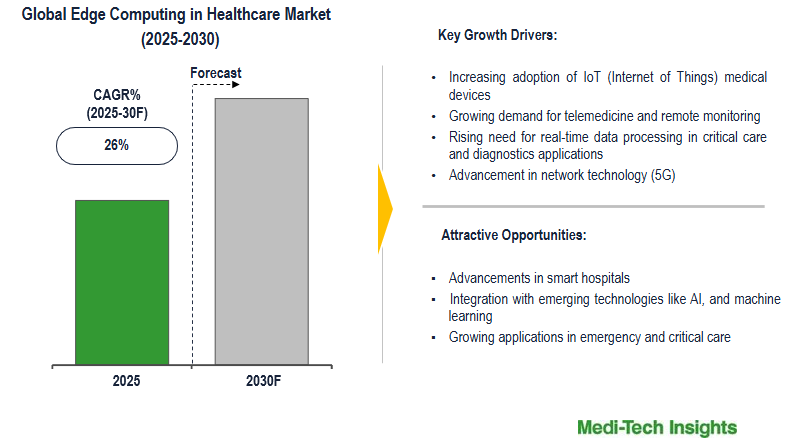
Edge computing in healthcare involves positioning computing power and data processing systems closer to the sources of medical data, enabling faster analysis critical for saving lives and improving patient outcomes. Unlike traditional cloud computing, which relies on centralized data centers, edge computing processes and stores data near its origin, such as Internet of Things (IoT) devices or smartphones. This approach significantly reduces latency and boosts overall system performance, making it ideal for applications requiring real-time data processing or decision-making in critical environments.
To learn more about this report, download the PDF brochure
Adoption of IoT medical devices fuels market growth
The integration of IoT medical devices with edge computing is revolutionizing the healthcare industry. Currently, there are approximately 10 billion IoT devices in use, including pacemakers, insulin pumps, and heart rate monitors. These devices generate vast amounts of data, which are processed and analyzed by software applications to support clinicians in delivering enhanced care. Edge computing technologies empower IoT wearable devices, equipped with advanced sensors, to continuously monitor various health metrics and detect anomalies in real-time. This capability improves response times for medical interventions and helps prevent severe health issues. Additionally, edge computing optimizes healthcare professionals' workloads by enabling them to prioritize critical cases that require immediate attention. As technology advances, the collaboration between IoT and edge computing is poised to drive even greater innovation, efficiency, and transformation in healthcare.
The growing application of edge computing in healthcare is expected to drive market growth
Edge computing is revolutionizing healthcare by enhancing both patient care and operational management. Some of its applications include:
- Remote Patient Monitoring: The proliferation of wearable technology has revolutionized patient data collection. Devices such as glucose monitors, heart rate monitors, and wearable trackers process data locally and send only actionable insights to healthcare providers, enabling timely interventions that can prevent complications or emergencies.
- Telehealth Platform: Edge computing enhances telehealth by reducing latency and improving the quality of video consultations. By processing data closer to the patient, edge computing ensures more reliable connections and faster response times, crucial for remote diagnostics and consultations.
- Medical Imaging: AI-powered edge devices can analyze X-rays, MRIs, or CT scans locally, delivering faster results without requiring large uploads to the cloud. This capability is particularly beneficial in emergencies where swift diagnoses are critical.
- AI-Assisted Diagnostics: Artificial Intelligence (AI) algorithms deployed at the edge can assist in diagnosing conditions from medical images. By processing data locally, edge computing reduces the latency associated with sending large image files to centralized servers for analysis. This ensures that AI-assisted diagnostics are performed rapidly, providing healthcare professionals with timely insights for quicker decision-making.
- Operational Efficiency in Healthcare Facilities: Smart hospitals utilize IoT (Internet of Things) devices and edge computing to enable real-time monitoring and management of various hospital operations. Devices such as connected IV pumps and environmental sensors leverage edge computing to streamline workflows, improve patient safety, lower operational costs, and enhance overall efficiency.
Challenges/ Constraints
The market faces several challenges, such as ensuring data privacy and security, addressing the complexities of integrating with existing healthcare systems and devices and managing the upfront costs associated with hardware, software, and infrastructure upgrades. Additionally, edge solutions must comply with stringent regulations like HIPAA (in the US) to safeguard patient data. Moreover, these systems need to be highly reliable and require regular maintenance to ensure uninterrupted operation.
To learn more about this report, download the PDF brochure
Competitive Landscape Analysis
The global edge computing in the healthcare market is marked by the presence of established and emerging market players such as ZPE Systems; Binariks; Amazon Web Services (AWS), Inc.; Aricent, Inc.; Atos; Cisco Systems, Inc.; General Electric Company; Hewlett Packard Enterprise Development; Honeywell International Inc.; Huawei Technologies Co., Ltd.; IBM Corporation; Intel Corporation; Akamai Technologies; Telco Systems; and Microsoft Corporation; among others. Some of the key strategies adopted by market players include new product development, strategic partnerships and collaborations, and investments.
Report Scope
| Report Metric | Details |
| Base Year Considered | 2024 |
| Historical Data | 2023 - 2024 |
| Forecast Period | 2025 - 2030 |
| Growth Rate | 26% |
| Market Drivers |
|
| Attractive Opportunities |
|
| Segment Scope | Component, Application, and End User |
| Regional Scope |
|
| Key Companies Mapped | ZPE Systems; Binariks; Amazon Web Services (AWS), Inc.; Aricent, Inc.; Atos; Cisco Systems, Inc.; General Electric Company; Hewlett Packard Enterprise Development; Honeywell International Inc.; Huawei Technologies Co., Ltd.; IBM Corporation; Intel Corporation; Akamai Technologies; Telco Systems; and Microsoft Corporation |
| Report Highlights | Market Size & Forecast, Growth Drivers & Restraints, Trends, Competitive Analysis |
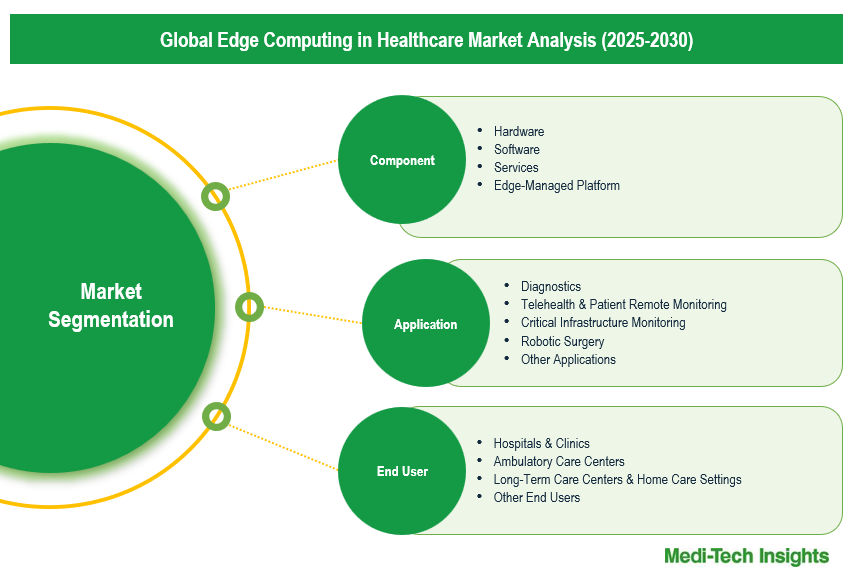
Global Edge Computing in Healthcare Market Segmentation
This report by Medi-Tech Insights provides thesize of the global edge computing in healthcare market at the regional- and country-level from 2023 to 2030. The report further segments the market based on component, application, and end user.
Market Size & Forecast (2023-2030), By Component, USD Million
- Hardware
- Software
- Services
- Edge-Managed Platform
Market Size & Forecast (2023-2030), By Application, USD Million
- Diagnostics
- Telehealth & Patient Remote Monitoring
- Critical Infrastructure Monitoring
- Robotic Surgery
- Other Applications
Market Size & Forecast (2023-2030), By End User, USD Million
- Hospitals & Clinbulatory Care Centers
- Long Term Care Centers & Home Care Settings
- Other End Users
Market Size & Forecast (2023-2030), By Region, USD Million
- North America
- US
- Canada
- Europe
- UK
- Germany
- Italy
- Spain
- Rest of Europe
- Asia Pacific
- China
- India
- Japan
- Rest of Asia Pacific
- Latin America
- Middle East & Africa
Frequently Asked Questions About This Report
What is the market size & forecast of edge computing in healthcare market?
What are the historical, present, and forecasted market shares and growth rates of various segments and sub-segments of edge computing in healthcare market?
What are the major factors impacting the market?
What are the opportunities prevailing in the market?
Which region has the highest share in the global market? Which region is expected to witness the highest growth rate in the next 5 years?
Need a More Tailored Analysis?
- Discuss the market sizing methodology and forecast assumptions with our healthcare analysts.
- Expand the scope with additional countries, market segments, technologies, or competitor profiling.
- Use the insights to support strategic planning, market entry, commercial due diligence, and long-term revenue growth initiatives.