Download FREE Sample


Report Overview
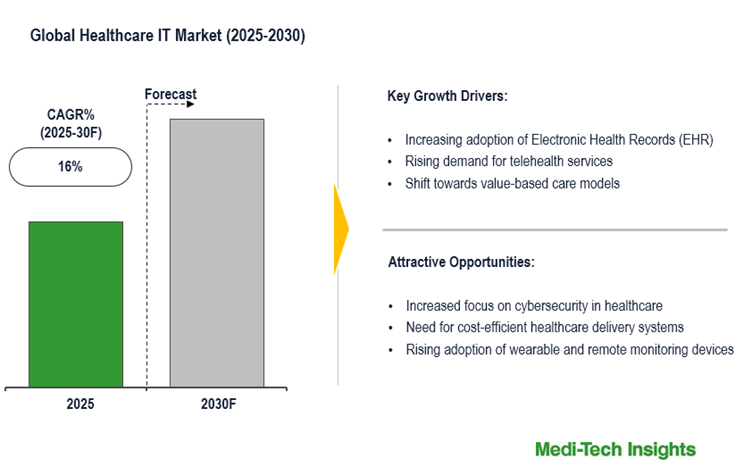
Healthcare IT encompasses the application of information technology to optimize healthcare services, enhancing patient outcomes, operational efficiency, and data management. It includes electronic health records (EHR), telemedicine, health analytics, clinical decision support systems, and revenue cycle management tools. The integration of IT in healthcare streamlines workflows facilitates seamless communication between providers, and improves patient safety by reducing errors. By leveraging advanced technologies, healthcare IT addresses critical challenges such as rising healthcare costs, data accessibility, and regulatory compliance.
To learn more about the research report, download a sample report.
Key Driver: Expansion of EHR Systems
The rapid expansion of electronic health record (EHR) systems has emerged as a pivotal force in the growth of the Healthcare IT market. Regulatory initiatives like the HITECH Act in the US, along with similar policies worldwide, have accelerated EHR adoption in healthcare facilities. These systems enhance patient care by offering accurate, real-time access to medical records, aiding healthcare providers in making informed decisions. EHRs also streamline communication among stakeholders, improving care coordination and minimizing redundancies. Moreover, their integration with other IT solutions, such as telemedicine and clinical decision support systems, broadens their scope of application. While initial implementation costs are significant, the long-term benefits of improved operational efficiency and better patient outcomes make EHRs a fundamental component of healthcare IT progress.
To learn more about the research report, download a sample report.
Rising Adoption of Mobile Health (mHealth) Applications
The expansion of mobile health (mHealth) applications has emerged as a significant trend in the healthcare IT market. These applications leverage smartphones, tablets, and wearable devices to deliver healthcare services, monitor patient health, and enhance communication between patients and providers. With the widespread penetration of mobile devices and increasing internet connectivity, mHealth solutions are revolutionizing how healthcare is accessed and delivered. They empower patients to manage their health proactively through features like appointment scheduling, medication reminders, and real-time health monitoring.
For healthcare providers, mHealth facilitates remote monitoring of patients, particularly those with chronic conditions, enabling timely interventions. The integration of mHealth with wearable technologies, such as fitness trackers and smartwatches, further enhances its capabilities by providing continuous data on vital parameters like heart rate and activity levels. With healthcare systems placing greater emphasis on patient engagement and preventive care, the use of mHealth applications is steadily increasing, becoming an integral part of modern digital health strategies.
Competitive Landscape Analysis
The global healthcare IT market is marked by the presence of established and emerging market players such as Philips Healthcare; McKesson Corporation; eMDs, Inc. (acquired by CompuGroup Medical (CGM)); Veradigm Inc.; Athenahealth, Inc.; GE Healthcare; Agfa- Gevaert Group; Hewlett Packard Enterprise Development LP; IBM; Oracle; SAS Institute, Inc.; IQVIA; SAP and Accenture among others. Some of the key strategies adopted by market players include new product development, strategic partnerships and collaborations, and geographic expansion.
Report Scope
| Report Scope | Details |
| Base Year Considered | 2024 |
| Historical Data | 2023 - 2024 |
| Forecast Period | 2025 - 2030 |
| Growth rate | 16% |
| Market Drivers |
|
| Attractive Opportunities |
|
| Segment Scope | Application, Delivery Mode and End-user |
| Regional Scope |
|
| Key Companies Mapped | Philips Healthcare; McKesson Corporation; eMDs, Inc. (acquired by CompuGroup Medical (CGM)); Veradigm Inc.; Athenahealth, Inc.; GE Healthcare; Agfa-Gevaert Group; Hewlett Packard Enterprise Development LP; IBM; Oracle; SAS Institute, Inc.; IQVIA; SAP and Accenture |
| Report Highlights | Market Size & Forecast, Growth Drivers & Restraints, Trends, Competitive Analysis |
Market Segmentation
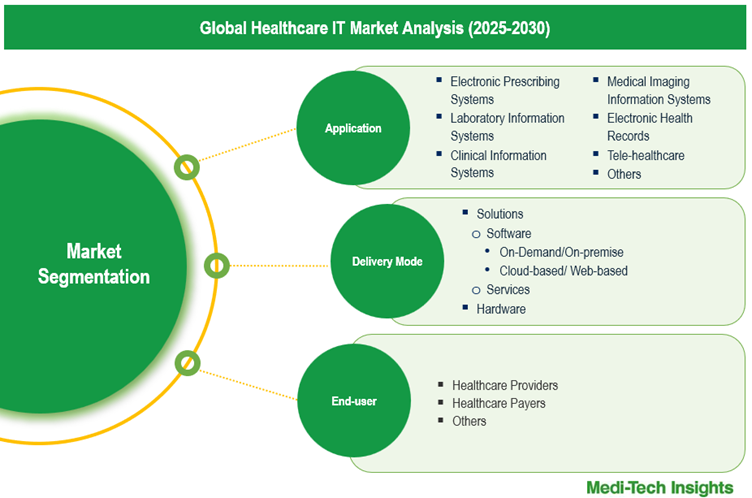
This report by Medi-Tech Insights provides thesize of the global healthcare IT market at theregional- and country-level from 2023 to 2030. The report further segments the market based on application, delivery mode and end-user.
- Market Size & Forecast (2023-2030), By Application, USD Billion
- Electronic Prescribing Systems (E-Prescribing Solutions)
- Laboratory Information Systems
- Clinical Information Systems
- Medical Imaging Information Systems
- Electronic Health Records
- Tele-healthcare
- Computerized Provider Order Entry Systems
- Revenue Cycle Management
- eClinical Solutions
- Population Health Management (PHM)
- Digital Healthcare Supply Chain Management
- Clinical Alarm Management
- Healthcare Customer Relationship Management (CRM)
- Technology Solutions for Healthcare Payers
- Healthcare Analytics
- Solutions
- Software
- On-Demand/On-premise
- Cloud-based/ Web-based
- Services
- Hardware
- Market Size & Forecast (2023-2030), By End-user, USD Billion
- Healthcare Providers
- Healthcare Payers
- Others
- Market Size & Forecast (2023-2030), By Region, USD Billion
- North America
- US
- Canada
- Europe
- UK
- Germany
- Italy
- Spain
- Rest of Europe
- Asia Pacific
- China
- India
- Japan
- Rest of Asia Pacific
- Latin America
- Middle East & Africa
- North America
Need a More Tailored Analysis?
- Discuss the market sizing methodology and forecast assumptions with our healthcare analysts.
- Expand the scope with additional countries, market segments, technologies, or competitor profiling.
- Use the insights to support strategic planning, market entry, commercial due diligence, and long-term revenue growth initiatives.