Download FREE Sample


An immunoassay is a bioanalytical test that uses the principles of immunology to detect the presence or concentration of a specific substance in a sample. This assay relies on antibodies, which are proteins generated by the immune system in response to a particular substance or antigen. Each antibody is highly specific and will only bind to its corresponding antigen. Immunoassays are widely used in clinical diagnostics, drug development, therapeutic drug monitoring, and food safety testing.
To learn more about this report, download the PDF brochure
Expanding applications of immunoassays drive market growth
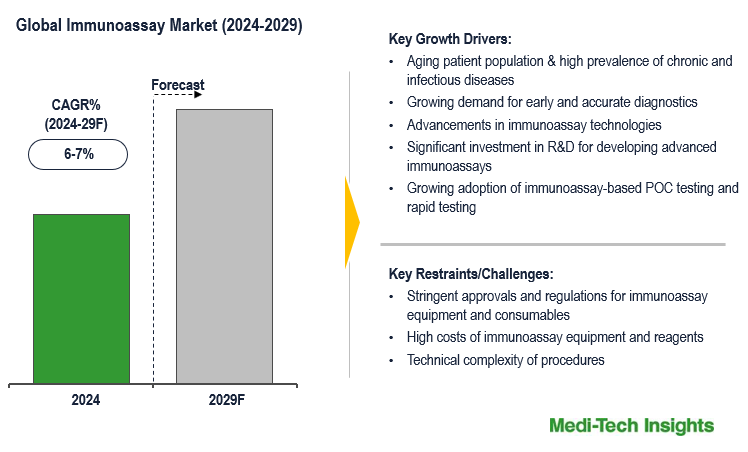
Immunoassays have diverse applications due to their ability to precisely detect and quantify specific substances across multiple fields. They are essential in disease diagnosis, allowing healthcare providers to identify disease-specific antigens or antibodies in blood or other bodily fluids, which aids in diagnosing and monitoring infections, autoimmune disorders, and cancers. In drug development, immunoassays support the identification and validation of targets for new drugs and assess how potential drugs interact with specific biomarkers. They are also widely used in environmental testing, detecting pollutants, toxins, and other contaminants in water, air, and soil to monitor environmental safety and protect public health. In the food industry, immunoassays detect foodborne pathogens, such as salmonella and E. coli, and identify allergens like gluten, nuts, and dairy proteins, ensuring food safety compliance. Thus, the growing demand for immunoassays in diagnostics, research, and quality control across various sectors is expected to drive market growth in the coming years.
Advancements in immunoassay technologies propel market growth
Continuous advancements in immunoassay technology are transforming medical diagnostics, enabling more precise, rapid, and comprehensive testing that supports improved patient outcomes and personalized medicine. New detection techniques, such as enhanced chemiluminescence, advanced fluorescence, and amplified enzyme-linked immunosorbent assays (ELISAs), have significantly pushed detection limits, improving assay sensitivity and accuracy. Multiplex immunoassays have also become invaluable for measuring multiple analytes within a single sample, offering a more holistic view of complex disease states. Additionally, integrating artificial intelligence and machine learning enables immunoassays to analyze complex datasets with greater efficiency, providing deeper insights and more accurate results. Looking ahead, advancements such as wearable biosensors and point-of-care diagnostic tools promise real-time health monitoring, which is further expected to propel market growth.
To learn more about this report, download the PDF brochure
Competitive Landscape Analysis
The global immunoassay market is marked by the presence of innovative and emerging market players such as Abbott Laboratories, Siemens Healthineers, Bio-Rad Laboratories, Danaher Corporation, bioMerieux, Quidel Corporation, BD Biosciences, Sysmex Corporation, GenScript, Quanterix, Thermo Fisher Scientific Inc., and Roche Diagnostics, among others. Some of the key strategies adopted by market players include product innovations, investing in R&D, strategic partnerships, and collaborations.
Report Scope
| Report Metric | Details |
| Base Year Considered | 2023 |
| Historical Data | 2022 - 2023 |
| Forecast Period | 2024 - 2029 |
| Growth Rate | CAGR of 6-7% |
| Market Drivers |
|
| Key Market Trends |
|
| Segment Scope | Product, Technology, Application, End User |
| Regional Scope |
|
| Key Companies Mapped | Abbott Laboratories, Siemens Healthineers, Bio-Rad Laboratories, Danaher Corporation, bioMerieux, Quidel Corporation, BD Biosciences, SysmexCorporation, GenScript, Quanterix, Thermo Fisher Scientific Inc., and Roche Diagnostics, among others |
| Report Highlights | Market Size & Forecast, Growth Drivers & Restraints, Trends, Competitive Analysis |
Market Segmentation
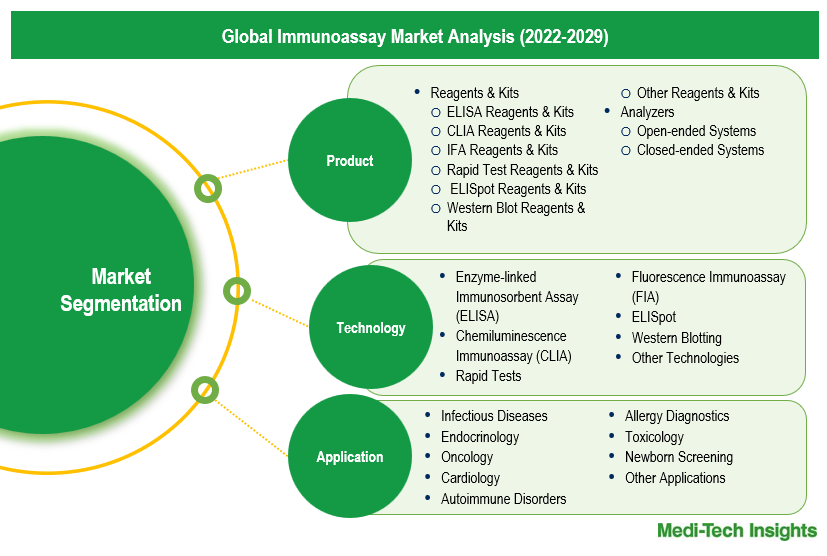
This report by Medi-Tech Insights provides thesize of the global immunoassay market at theregional- and country level from 2022 to 2029. The report further segments the market based on product, technology, application, and end user.
- Market Size & Forecast (2022-2029), By Product, USD Million
- Reagents & Kits
- ELISA Reagents & Kits
- CLIA Reagents & Kits
- IFA Reagents & Kits
- Rapid Test Reagents & Kits
- ELISpot Reagents & Kits
- Western Blot Reagents & Kits
- Other Reagents & Kits
- Analyzers
- Open-ended Systems
- Closed-ended Systems
- Reagents & Kits
- Market Size & Forecast (2022-2029), By Technology, USD Million
- Enzyme-linked Immunosorbent assay (ELISA)
- Chemiluminescence Immunoassay (CLIA)
- Fluorescence Immunoassay (FIA) Tests
- ELISpot
- Western Blotting
- Other Technologies
- Market Size & Forecast (2022-2029), By Application, USD Million
- Infectious Diseases
- Endocrinology
- Oncology
- Cardiology
- Autoimmune Disorders
- Allergy Diagnostics
- Toxicology
- Newborn Screening
- Other Applications
- Market Size & Forecast (2022-2029), By End User, USD Million
- Hospitals & Clinics
- Clinical Laboratories
- Pharmaceuticals & Biotechnology Companies & CROs
- Blood Banks
- Research & Academic Laboratories
- Home Care Settings
- Market Size & Forecast (2022-2029), By Region, USD Million
- North America
- US
- Canada
- Europe
- UK
- Germany
- France
- Italy
- Spain
- Rest of Europe
- Asia Pacific
- China
- India
- Japan
- Rest of Asia Pacific
- Latin America
- Middle East & Africa
- North America
Frequently Asked Questions About This Report
What is the market size & forecast of the immunoassay market?
What are the historical, present, and forecasted market shares and growth rates of various segments and sub-segments of the immunoassay market?
What are the key trends defining the market?
What are the major factors impacting the market?
What are the opportunities prevailing in the market?
Need a More Tailored Analysis?
- Discuss the market sizing methodology and forecast assumptions with our healthcare analysts.
- Expand the scope with additional countries, market segments, technologies, or competitor profiling.
- Use the insights to support strategic planning, market entry, commercial due diligence, and long-term revenue growth initiatives.