Download FREE Sample


Report Overview
Medical billing software is a digital tool designed to automate healthcare invoicing and enhance business management processes. It enables billing and medical practice companies to streamline reimbursement processes, manage patient information efficiently, and maximize revenue optimization. Medical billing solutions seamlessly integrate with EHRs and PMS, ensuring accurate patient and billing data exchange reducing data duplication, and enhancing interoperability across healthcare IT systems.
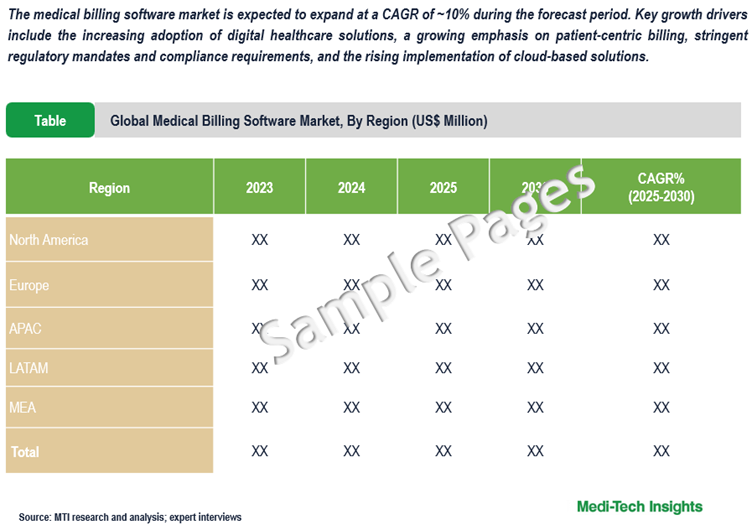
Adoption of cloud-based solutions in medical billing software boosts market growth
The adoption of cloud-based medical billing software is rapidly increasing due to its significant advantages over traditional on-premise systems. Cloud technology empowers healthcare providers, billing companies, and hospitals to optimize revenue cycle management while ensuring scalability, security, and regulatory compliance. By eliminating the need for costly hardware and infrastructure, cloud-based solutions reduce upfront capital expenses and operate on a subscription-based (SaaS) model, making them more accessible for small and mid-sized healthcare providers.
These solutions offer seamless scalability to accommodate growing patient volumes, making them ideal for expanding healthcare organizations. Additionally, cloud-based billing software enables healthcare professionals and billing teams to access the system remotely via an internet connection, which is especially beneficial for telehealth services, remote billing teams, and multi-location practices. The increasing focus on value-based care drives demand for efficient, data-driven billing solutions, further accelerating cloud adoption. Emerging technologies such as blockchain for secure transactions and AI-driven automation are enhancing the capabilities of cloud-based billing software. As the need for cost-effective, AI-powered, and interoperable billing solutions grows, cloud technology will continue revolutionizing the healthcare revenue cycle, benefiting organizations of all sizes.
Digital transformation in medical billing software drives market growth
With advancements in cloud computing, artificial intelligence (AI), automation, and interoperability, healthcare providers and billing companies are shifting towards digital platforms to streamline operations and optimize financial performance. Some of the digital transformations in medical billing software include:
- Automation & Efficiency: Digital medical billing software automates reimbursement procedures and bill claims and optimizes operational efficiencies. This software automates everyday tasks, saves time, and minimizes the scope of human errors. This includes generating claims submission, payment posting, and invoices, streamlining the entire billing cycle effectively.For instance,
-
- In January 2024: Microsoft Corporation unveiled its AI tool, DAX Copilot, to automate clinical documentation within Epic's health records software. Integrated into Epic's Haiku mobile app, the tool drafts clinician notes for immediate review, aiming to streamline the time-consuming note-taking process, a frequent complaint in healthcare systems
- Adoption of AI & Machine Learning: AI-driven billing systems identify coding errors, predict claim denials, and suggest corrections before submission. AI-powered analytics help in fraud detection, predictive revenue forecasting, and claims optimization. Also, enhances decision-making with data-driven insights for healthcare providers. For instance,
- In August 2024, MediPortal PTY LTD. (MediPortal) introduced an AI-powered medical platform for general practitioners in Australia and New Zealand. In addition to medical billing, this platform offers speech-to-text medical transcription and a care plan generator powered by AI
- Compliance with Regulatory & Security Standards: Medical billing software enables practices to adhere more effectively to applicable regulations, including HIPPA and ICD-10 coding standards. In addition, automated updates ensure compliance with the latest regulations without additional effort from staff while reducing risks associated with manual billing errors and non-compliance penalties
Competitive Landscape Analysis
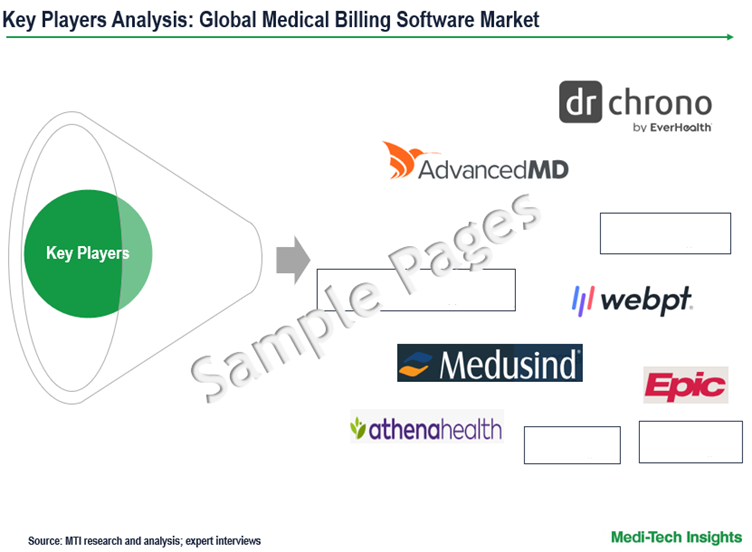
The global medical billing software market is marked by the presence of established and emerging market players such as Kareo Inc. (tebra Company); WebPT, Inc.; Athenahealth; ADT; Cognizant; Epic Systems Corporation.; DrChrono (EverHealth Solutions Inc.); Greenway Health; eClinicalWorks; AGS Health; CompuGroup Medical; NextGen Healthcare; Cerner Corporation; AdvancedMD, Inc.; Digitech Computer LLC; Compulink Advantage; and Medusind among others. Some of the key strategies adopted by market players include new product development, strategic partnerships and collaborations, and investments.
Report Scope
| Report Scope | Details |
| Base Year Considered | 2024 |
| Historical Data | 2023 - 2024 |
| Forecast Period | 2025 - 2030 |
| Growth Rate | ~10% |
|
Market Drivers |
|
|
Attractive Opportunities |
|
| Segment Scope | Billing Type, Deployment Mode, and End User |
| Regional Scope |
|
| Key Companies Mapped | Kareo Inc. (tebra Company); WebPT, Inc.; Athenahealth; ADT; Cognizant; Epic Systems Corporation.; DrChrono (EverHealth Solutions Inc.); Greenway Health; eClinicalWorks; AGS Health; CompuGroup Medical; NextGen Healthcare; Cerner Corporation; AdvancedMD, Inc.; Digitech Computer LLC; Compulink Advantage; and Medusind |
| Report Highlights | Market Size & Forecast, Growth Drivers & Restraints, Trends, Competitive Analysis |
Market Segmentation
This report by Medi-Tech Insights provides thesize of the global medical billing software market at theregional- and country-level from 2023 to 2030. The report further segments the market based on billing type, deployment mode, and end user.
- Market Size & Forecast (2023-2030), By Billing Type, USD Million
- Professional Billing
- Institutional Billing
- Others
- Market Size & Forecast (2023-2030), By Deployment Mode, USD Million
- On-Premise
- Web-Based
- Cloud-Based
- Market Size & Forecast (2023-2030), By End User, USD Million
- Healthcare Providers
- Healthcare Payers
- Others
- Market Size & Forecast (2023-2030), By Region, USD Million
- North America
- US
- Canada
- Europe
- UK
- Germany
- Italy
- Spain
- Rest of Europe
- Asia Pacific
- China
- India
- Japan
- Rest of Asia Pacific
- Latin America
- Middle East & Africa
- North America
Key Strategic Questions Addressed
- What is the market size & forecast of the medical billing software market?
- What are the historical, present, and forecasted market shares and growth rates of various segments and sub-segments of the medical billing software market?
- What are the key trends defining the market?
- What are the major factors impacting the market?
- What are the opportunities prevailing in the market?
- Which region has the highest share in the global market? Which region is expected to witness the highest growth rate in the next 5 years?
- Who are the major players operating in the market?
- What are the key strategies adopted by players?
Need a More Tailored Analysis?
- Discuss the market sizing methodology and forecast assumptions with our healthcare analysts.
- Expand the scope with additional countries, market segments, technologies, or competitor profiling.
- Use the insights to support strategic planning, market entry, commercial due diligence, and long-term revenue growth initiatives.