Download FREE Sample


Report Overview
Minimally invasive cardiac surgery (MICS), sometimes referred to as keyhole heart surgery, is a sophisticated technique used to perform heart bypass procedures for treating coronary heart disease. In this approach, the surgeon uses specialized surgical instruments to access the heart through a small incision on the left side of the chest. Unlike traditional open-heart surgery, which requires opening the chest cavity, MICS allows access through the natural spaces between the ribs without the need for cutting. This method is less invasive, resulting in reduced trauma and quicker patient recovery. 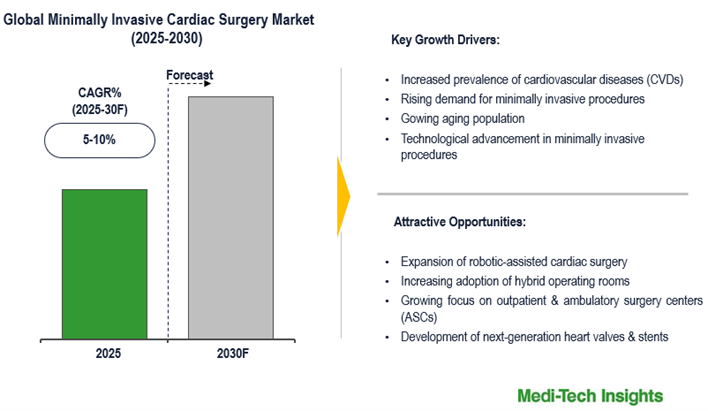
To learn more about the research report, download a sample report.
Growing demand for minimally invasive cardiac surgery procedures fuels its demand
Minimally invasive cardiac procedures have revolutionized heart surgery by offering safer and less invasive alternatives to traditional open-heart techniques. The adoption of these methods is rapidly growing, driven by the need to reduce patient trauma, shorten recovery times, and lower healthcare costs. Procedures like cardiac catheterization and percutaneous coronary intervention are increasingly preferred due to their significant benefits over conventional approaches. These techniques utilize specialized cardiology devices, such as catheters, stents, and guidewires, which are witnessing rising demand. Moreover, minimally invasive approaches are widely applied in various cardiac surgeries, including mitral valve repair, coronary artery bypass grafting, and aortic valve replacement, further accelerating market growth. 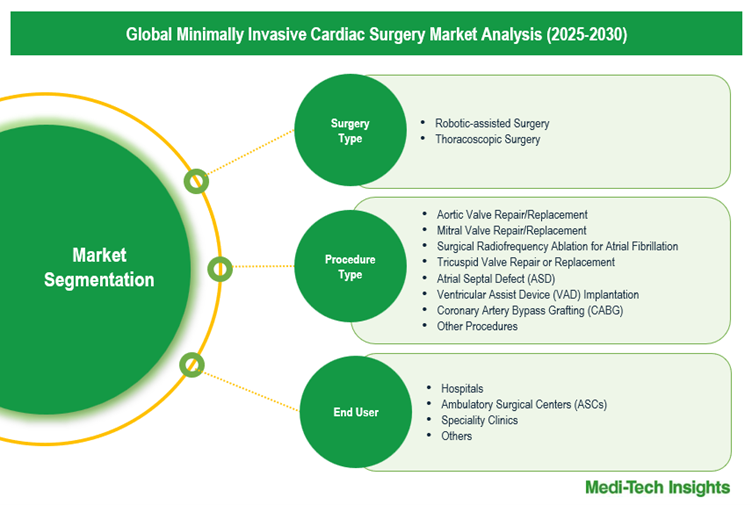
To learn more about the research report, download a sample report.
Shift towards minimally invasive cardiac surgery over traditional heart surgery drives market growth
Minimally invasive cardiac surgery (MICS) has transformed the treatment of various heart conditions, offering a safer and equally effective alternative to traditional open-heart surgery. It provides several significant advantages over conventional methods:
- Smaller Incisions & Less Pain: With minimal incisions on the breastbone, MICS reduces post-operative pain and scarring. This approach also preserves chest function and improves breathing after surgery
- Faster Recovery & Return to Daily Activities: Unlike traditional heart surgeries, MICS allows patients to resume normal activities, such as driving and working, much sooner often immediately after the initial recovery phase
- Minimal Blood Loss & Reduced Need for Transfusion: The use of robotic instruments and small incisions minimizes blood loss during the procedure, significantly lowering the need for transfusions and reducing the risk of blood-borne infections
- Lower Risk of Post-Surgical Infections: Due to the smaller incisions, MICS greatly decreases the likelihood of infections, making it particularly beneficial for diabetic and elderly patients with weaker immune systems
- Minimal Scarring & Faster Healing: With incisions as small as 2-4 inches, scarring is virtually non-existent, leading to quicker wound healing with fewer complications
- Shorter Hospital Stays: One of the greatest advantages of MICS is the reduced recovery period. Patients typically stay in the hospital for about five days, compared to nine days for those undergoing traditional open-heart surgery, enabling a faster return to normal life with less rehabilitative care.
By combining advanced surgical techniques with enhanced patient outcomes, MICS continues to redefine the landscape of modern cardiac surgery.
Competitive Landscape Analysis
The global minimally invasive cardiac surgery market is marked by the presence of established and emerging market players such as Abbott Laboratories; Intuitive Surgical; Stryker Corporation; GE HealthCare; Edwards Lifesciences Corporation; Siemens Healthineers; Terumo Corporation; Johnson & Johnson; Philips Healthcare; Medtronic; Boston Scientific Corporation; Zimmer Biomet; Smith & Nephew; Olympus Corporation; and Micro Interventional Devices (MID); among others. Some of the key strategies adopted by market players include new product development, strategic partnerships and collaborations, and investments.
Report Scope
| Report Scope | Details |
| Base Year Considered | 2024 |
| Historical Data | 2023 - 2024 |
| Forecast Period | 2025 - 2030 |
| Growth Rate | 5-10% |
| Market Drivers |
|
| Attractive Opportunities |
|
| Segment Scope | Surgery Type, Procedure Type, and End User |
| Regional Scope |
|
| Key Companies Mapped | Abbott Laboratories; Intuitive Surgical; Stryker Corporation; GE HealthCare; Edwards Lifesciences Corporation; Siemens Healthineers; Terumo Corporation; Johnson & Johnson; Philips Healthcare; Medtronic; Boston Scientific Corporation; Zimmer Biomet; Smith & Nephew; Olympus Corporation; and Micro Interventional Devices (MID) |
| Report Highlights | Market Size & Forecast, Growth Drivers & Restraints, Trends, Competitive Analysis |
Market Segmentation
This report by Medi-Tech Insights provides the size of the global minimally invasive cardiac surgery market at the regional- and country-level from 2023 to 2030. The report further segments the market based on surgery type, procedure type, and end user.
- Market Size & Forecast (2023-2030), By Surgery Type, USD Million
- Robotic-assisted Surgery
- Thoracoscopy Surgery
- Market Size & Forecast (2023-2030), By Procedure Type, USD Million
- Aortic Valve Repair/Replacement
- Mitral Valve Repair/Replacement
- Surgical Radiofrequency Ablation for Atrial Fibrillation
- Tricuspid Valve Repair or Replacement
- Atrial Septal Defect (ASD)
- Ventricular Assist Device (VAD) Implantation
- Coronary Artery Bypass Grafting (CABG)
- Other Procedures
- Market Size & Forecast (2023-2030), By End User, USD Million
- Hospitals
- Ambulatory Surgical Centers (ASCs)
- Speciality Clinics
- Others
- Market Size & Forecast (2023-2030), By Region, USD Million
- North America
- US
- Canada
- Europe
- UK
- Germany
- France
- Italy
- Spain
- Rest of Europe
- Asia Pacific
- China
- India
- Japan
- Rest of Asia Pacific
- Latin America
- Middle East & Africa
- North America
Need a More Tailored Analysis?
- Discuss the market sizing methodology and forecast assumptions with our healthcare analysts.
- Expand the scope with additional countries, market segments, technologies, or competitor profiling.
- Use the insights to support strategic planning, market entry, commercial due diligence, and long-term revenue growth initiatives.