Download FREE Sample


Report Overview
Point of care molecular diagnostics refers to advanced diagnostic testing conducted at or near the patient site, enabling rapid detection of pathogens and genetic markers. Unlike traditional lab-based molecular diagnostics, POC molecular testing integrates sample preparation, amplification, and detection into a compact system, reducing turnaround time from hours to minutes. These diagnostics leverage technologies like PCR and isothermal amplification, ensuring high sensitivity and specificity in detecting infectious diseases, genetic conditions, and oncology markers. Their significance lies in improving early diagnosis, guiding timely treatment, and enhancing healthcare accessibility, particularly in remote or under-resourced areas.
To learn more about the research report, download a sample report.
Widespread infectious disease burden accelerating market growth
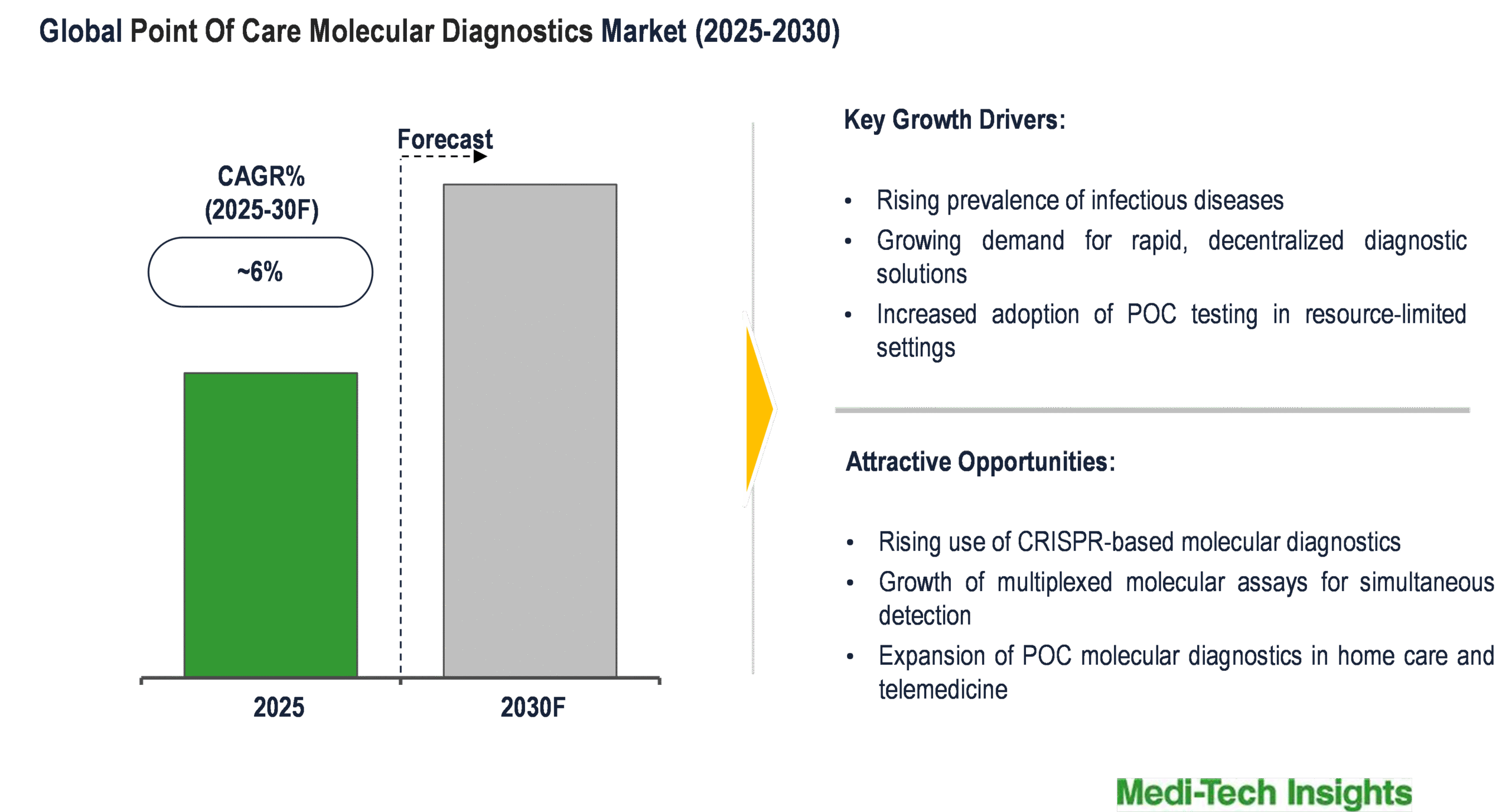
The increasing prevalence of infectious diseases is a primary factor fueling the expansion of the POC Molecular Diagnostics market. The growing global burden of respiratory infections, sexually transmitted diseases, and emerging viral outbreaks necessitates rapid and decentralized diagnostic solutions. Conventional laboratory-based molecular diagnostics, while highly accurate, often require centralized facilities and lengthy turnaround times, delaying treatment decisions. POC molecular platforms bridge this gap by delivering near-instant results at the patient-s location, facilitating prompt clinical intervention. Additionally, healthcare systems in low- and middle-income countries benefit from these rapid diagnostics, as they reduce the dependency on specialized infrastructure and skilled personnel. The COVID-1ic further underscored the importance of fast, accurate molecular testing at the point of care, accelerating investment in portable diagnostic devices. As healthcare providers prioritize early disease detection and containment strategies, the demand for POC molecular diagnostics continues to surge, reshaping infectious disease management worldwide.
To learn more about the research report, download a sample report.
Microfluidics revolutionizing POC molecular testing
Microfluidic-based POC molecular diagnostics represent a significant innovation enhancing the market-s effectiveness and adoption. Microfluidics enables the miniaturization and automation of molecular assays, integrating multiple testing steps-sample extraction, amplification, and detection-into a single, compact chip. These systems require minimal sample volumes, reducing reagent costs while maintaining high analytical sensitivity. Additionally, microfluidic platforms improve assay reproducibility and reliability, addressing variability concerns in traditional manual methods. The portability of microfluidic-based devices makes them ideal for field settings, rural clinics, and emergency response situations, where timely diagnostics are critical. Moreover, advancements in lab-on-a-chip technology have streamlenabling non-specialists to conduct sophisticated molecular testing with minimal training. As the technology matures, microfluidic POC diagnostics are expected to drive broader adoption, particularly in infectious disease surveillance, antimicrobial resistance monitoring, and personalized medicine applications.
Competitive Landscape Analysis
The global point of care molecular diagnostics market is marked by the presence of established and emerging market players such as Abbott; F. Hoffmann-La Roche AG; QIAGEN; Danaher; Bio-Rad Laboratories, Inc.; bioMrieux; Agilent Technologies, Inc.; Nova Biomedical; Nipro Diagnostics and Thermo Fisher Scientific among others. Some of the key strategies adopted by market players include new product development, strategic partnerships and collaborations, and geographic expansion.
Report Scope
|
Report Scope |
Details |
|
Base Year Considered |
2024 |
|
Historical Data |
2023 - 2024 |
|
Forecast Period |
2025 - 2030 |
|
Growth |
6% |
|
Market Drivers |
|
|
Attractive Opportunities |
|
|
Segment Scope |
Technology, Application, and End-user |
|
Regional Scope |
|
|
Key Companies Mapped |
Abbott; F. Hoffmann-La Roche AG; QIAGEN; Danaher; Bio-Rad Laboratories, Inc.; bioMrieux; Agilent Technologies, Inc.; Nova Biomedical; Nipro Diagnostics and Thermo Fisher Scientific among others |
|
Report Highlights |
Market Size & Forecast, Growth Drivers & Restraints, Trends, Competitive Analysis |
Market Segmentation
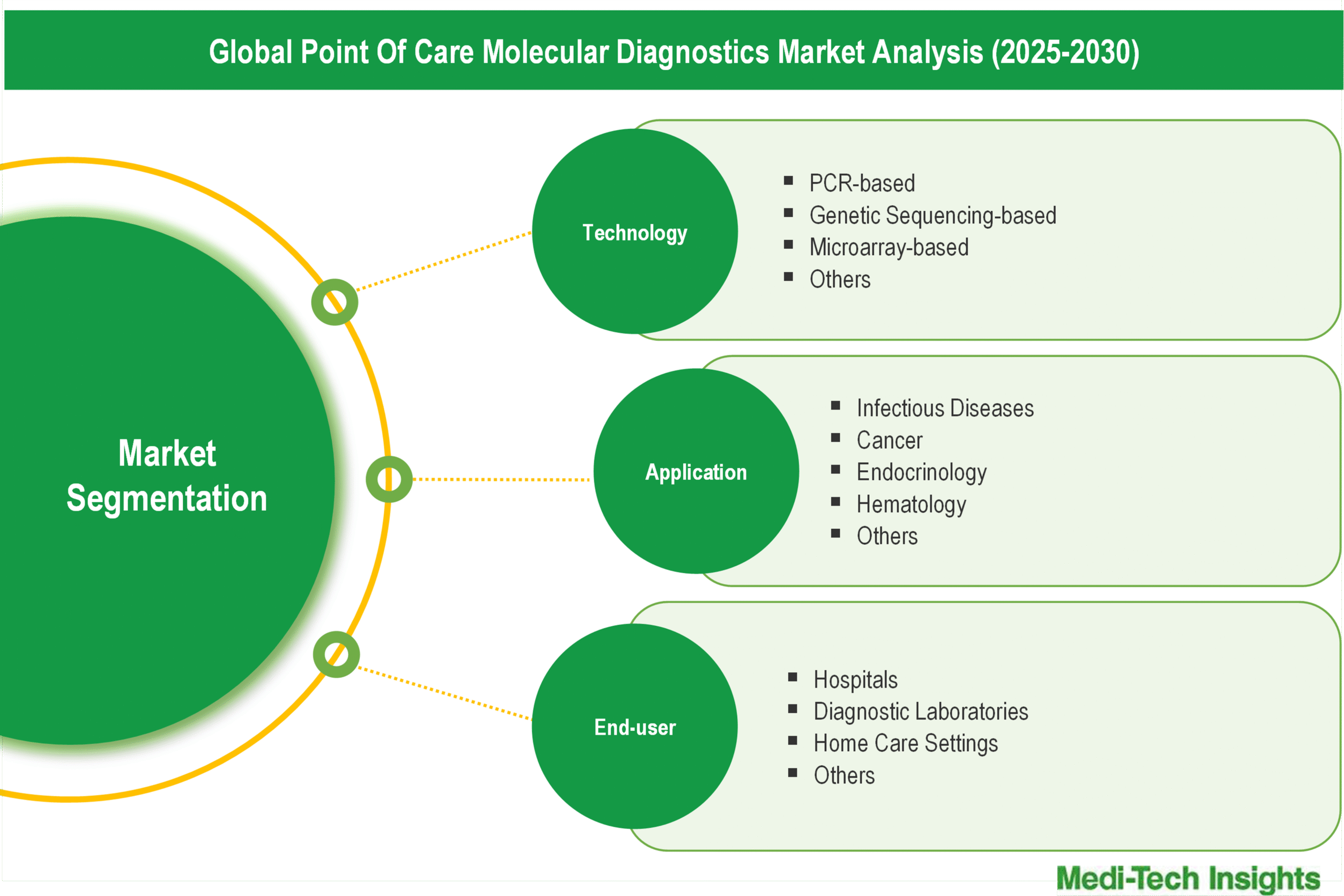
This report by Medi-Tech Insights provides thesize of the point of care molecular diagnostics market at theregional- and country-level from 2023 to 2030. The report further segments the market based on technology, application and end-user.
- Market Size & Forecast (2023-2030), By Technology, USD Million
- PCR-based
- Genetic Sequencing-based
- Microarray-based
- Others
- Market Size & Forecast (2023-2030), By Application, USD Million
- Infectious Diseases
- Cancer
- Endocrinology
- Hematology
- Others
- Market Size & Forecast (2023-2030), By End-user, USD Million
- Hospitals
- Diagnostic Laboratories
- Home Care Settings
- Others
- Market Size & Forecast (2023-2030), By Region, USD Million
- North America
- USCanada
- Europe
- UK
- Germany
- France
- Italy
- Spain
- Rest of Europe
- Asia Pacific
- China
- India
- Japan
- Rest of Asia Pacific
- Latin America
- Middle East & Africa
- North America
Need a More Tailored Analysis?
- Discuss the market sizing methodology and forecast assumptions with our healthcare analysts.
- Expand the scope with additional countries, market segments, technologies, or competitor profiling.
- Use the insights to support strategic planning, market entry, commercial due diligence, and long-term revenue growth initiatives.