Download FREE Sample


Protein A resin is a type of chromatography resin commonly used in applications like antibody purification and immunoprecipitation. Protein A resin, due to its high binding capacity, is widely used in the purification of antibodies. During this process, the resins bind to their Fc region, typically requiring less time compared to other purification methods, thereby offering high purity and good yield.
Surge in mAb Therapies Driving Demand for Scalable Purification Solutions
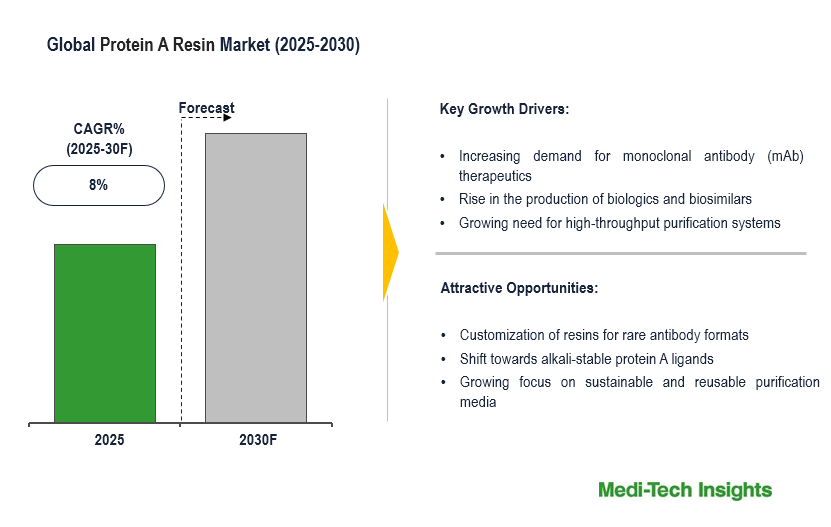
The most prevalent driver of the protein A resin market growth is the increasing demand for monoclonal antibody-based therapies in oncology, autoimmune disorders, and infectious diseases. With the increased investments in developing mAbs by more biopharmaceutical companies because of their high specificity and therapeutic potential, there has been a surge in the need for effective purification tools in turn. Protein A resin is still the gold standard for the large-scale capture of antibodies due to its high binding affinity and ease of operation. Its reliability under GMP (Good Manufacturing Practice) conditions also makes it a choice of preference for regulatory convenience. In addition, as more FDA approvals for monoclonal antibody drugs come through, manufacturers are facing the heat to expand production rapidly and dependably. This has resulted in increased investment in downstream purification facilities, directly benefiting the protein A resin market. Moreover, the therapeutic dependence on mAbs guarantees long-term demand for strong and scalable purification technologies such as protein A resins.
To learn more about this report, download the PDF brochure
Next-Gen Protein A Resins Enable Cost-Effective Biomanufacturing
One significant advancement enhancing protein A resin performance is the creation of alkali-stable protein A ligands. Standard protein A ligands will deteriorate if they come into contact with harsh cleansing agents such as sodium hydroxide, reducing their ability to be reused and increasing operating costs. Alkali-tolerant alternatives now available can withstand multiple cycles of cleaning using harsh sanitizing agents without loss of performance while substantially increasing resin lifespan. This resilience is especially valuable in industrial-scale manufacturing, where reusability directly determines cost savings. Moreover, such enhanced ligands minimize risks of contamination and promote process reproducibility, which is essential for winning regulatory approval and patient safety. The availability of high-capacity, alkali-stable resins has further facilitated manufacturers' ability to control batch-to-batch reproducibility while minimizing resin replacement. This innovation not only promotes greener bioprocessing strategies but also aligns with the increasing industry movement toward intensified and continuous biomanufacturing processes.
To learn more about this report, download the PDF brochure
Competitive Landscape Analysis
The global protein A resin market is marked by the presence of established and emerging market players such as Merck Millipore; GenScript Biotech Corp.; Agilent Technologies; Repligen Corporation; Danaher Corporation; Thermo Fisher Scientific, Inc.; Bio-Rad Laboratories, Inc.; Abcam PLC; PerkinElmer, Inc.; and Avantor, Inc. among others. Some of the key strategies adopted by market players include new product development, strategic partnerships and collaborations, and geographic expansion.
Report Scope
| Report Metric | Details |
| Base Year Considered | 2024 |
| Historical Data | 2023 - 2024 |
| Forecast Period | 2025 - 2030 |
| Growth | 8% |
| Market Drivers |
|
| Attractive Opportunities |
|
| Segment Scope | Type, Product, Application and End-user |
| Regional Scope |
|
| Key Companies Mapped | Merck Millipore; GenScript Biotech Corp.; Agilent Technologies; Repligen Corporation; Danaher Corporation; Thermo Fisher Scientific, Inc.; Bio-Rad Laboratories, Inc.; Abcam PLC; PerkinElmer, Inc.; and Avantor, Inc. among others |
| Report Highlights | Market Size & Forecast, Growth Drivers & Restraints, Trends, Competitive Analysis |
Global Protein A Resin Market Segmentation
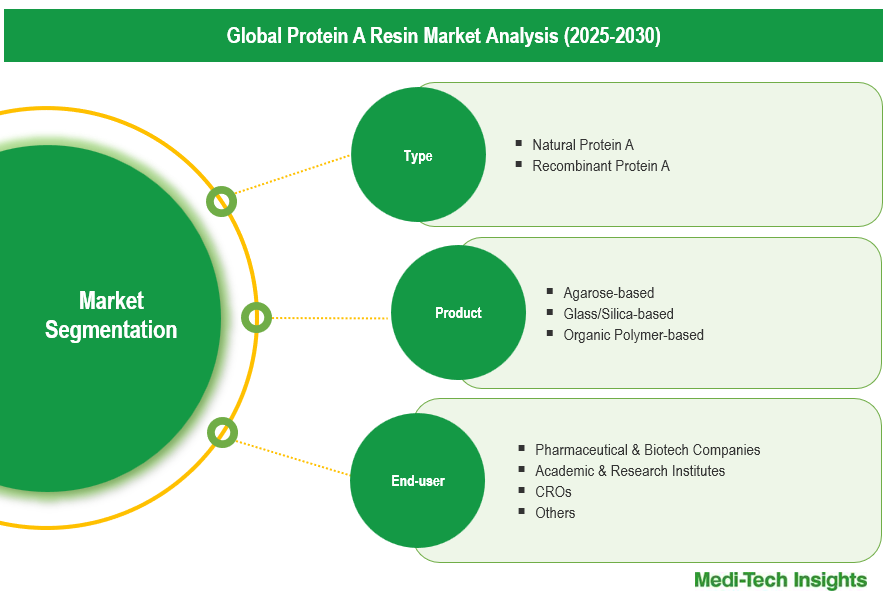
This report by Medi-Tech Insights provides thesize of the global protein A resin market at theregional- and country-level from 2023 to 2030. The report further segments the market based on type, product, application and end-user.
Market Size & Forecast (2023-2030), By Type, USD Million
- Natural Protein A
- Recombinant Protein A
Market Size & Forecast (2023-2030), By Product, USD Million
- Agarose-based
- Glass/Silica-based
- Organic Polymer-based
Market Size & Forecast (2023-2030), By Application, USD Million
- Antibody Purification
- Immunoprecipitation
Market Size & Forecast (2023-2030), By End-user, USD Million
- Phmp; Biotech Companies
- Academic & Research Institutes
- CROs
- Others
Market Size & Forecast (2023-2030), By Region, USD Million
- North America
- US
- Canada
- Europe
- UK
- Germany
- France
- Italy
- Spain
- Rest of Europe
- Asia Pacific
- China
- India
- Japan
- Rest of Asia Pacific
- Latin America
- Middle East & Africa
Need a More Tailored Analysis?
- Discuss the market sizing methodology and forecast assumptions with our healthcare analysts.
- Expand the scope with additional countries, market segments, technologies, or competitor profiling.
- Use the insights to support strategic planning, market entry, commercial due diligence, and long-term revenue growth initiatives.