Download FREE Sample


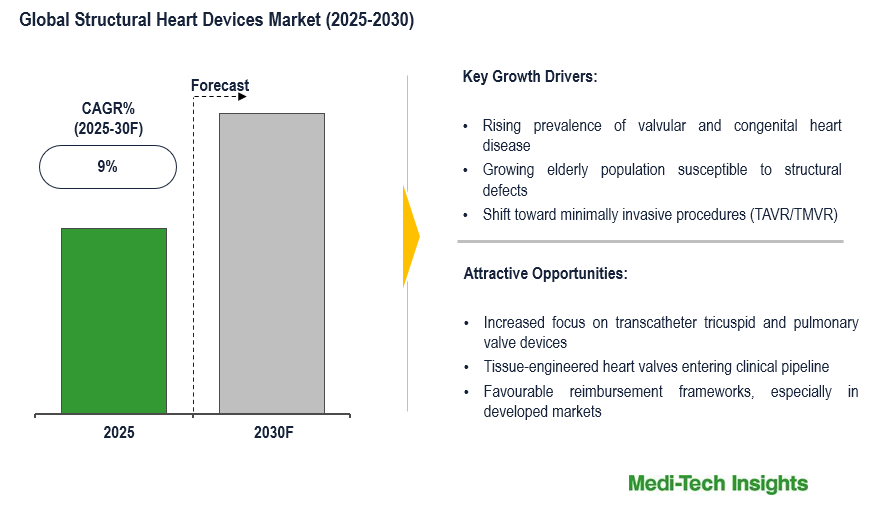
The global structural heart devices market is set to witness a CAGR of ~9% in the next 5 years. The rising geriatric population & corresponding rise in the prevalence of heart disease, technological advancements in structural heart devices, regulatory approval for expanded indications for several transcatheter heart valves, and increasing awareness and favorable reimbursements for these procedures in key markets are some of the pivotal factors driving the growth of the structural heart devices market. However, high device costs, complex procedures, and stringent regulatory hurdles continue to restrain market uptake.
Structural heart disease occurs when something is wrong with one-s heart valves, walls, chambers or muscles. It exists from birth or develops as one age. It includes conditions such as congenital heart disease, cardiomyopathy, and heart valve disease. Heart valve devices, occluders & delivery systems, annuloplasty rings, heart access systems, closure devices, introducers, sheaths, balloon catheters, and accessories are some of the devices used for structural heart disease treatment.
Surge in valvular heart diseases expands the horizon for structural heart devices
One of the most significant drivers propelling market growth is the escalating prevalence of valvular heart disease, largely tied to the aging global population. Chronic heart conditions such as mitral regurgitation, aortic stenosis and heart failure, among others, are common due to aging populations, sedentary lifestyle, and the growing impact of conditions like hypertension and diabetes. Procedures like TAVR were earlier used to treat high-risk surgical patients, but with significant technological advancements, better patient outcomes and expanded clinical guidelines by healthcare organizations, it is now being adopted for treating intermediate and low-risk patients. As a result, there is a substantial rise in the number of patients, which has led to the higher demand for structural heart devices like transcatheter valves and occluders that offer less invasive alternatives compared to traditional open-heart surgery. Further with advancements in diagnostic tools, like echocardiography and CT scanning, ensure the early diagnosis of structural heart diseases and their prevention, allowing more patients to be channelled towards interventional therapies. Further, all the developments have substantially increased procedure volumes and structural heart device demand across healthcare systems.
Emerging solutions in mitral and tricuspid regurgitation fuel structural heart market growth
In the field of structural heart disease, interventional treatment for mitral regurgitation is one of the most challenging areas but showcases huge market potential. Mitral valve regurgitation is the most common type of heart valve disease in which the valve between the left heart chambers does not close completely, allowing blood to leak backwards across the valve. Similarly, tricuspid regurgitation is a highly prevalent but rarely treated disease. It occurs when the valve-s flaps do not close properly. As a result, blood can leak backwards into the atrium from the leaky tricuspid valve, causing the heart to pump harder to move blood through the valve.
With the rise in several product innovations, including transcatheter aortic valve replacement (TAVR), the MitraClip mitral valve repair system and other products used in interventional procedures, there has been a significant increase in the volume of structural heart procedures to treat complex patients. Citing the lucrative prospects and unmet needs of the market, players operating in the market are launching innovative devices to address the demand. For instance,
- In May 2025, Edwards Lifesciences received FDA approval for its SAPIEN-3 TAVR platform, including SAPIEN-3 Ultra and Ultra-RESILIA, to treat patients with severe aortic stenosis who are asymptomatic
- In April-2024, Abbott announced that the FDA had ge repair (TEER) system, which is the first minimally invasive device designed to clip together the leaflets of a leaky tricuspid valve, offering a safer alternative for patients with high surgical risk
- In January 2022,InnovHeart s.r.l., a developer of novel Transcatheter Mitral Valve Replacement (TMVR) systems for the treatment of mitral valve disease raised $55 million in Series C financing to further develop the Trans-septal Saturn Transcatheter Mitral Valve Replacement System
Organic and inorganic growth strategies adopted by players to establish their foothold in the structural heart devices market
The structural heart devices market is marked by the presence of both established and new players. Players operating in the market adopt both organic and inorganic growth strategies, such as acquisitions and new product launches, to garner market share. For instance,
- In July 2024, Edwards Lifesciences announced that it had entered into an agreement to acquire JenaValve Technology, a pioneer in transcatheter treatment for aortic regurgitation, to expand its structural heart portfolio
- In February 2022,Genesis MedTech Group completed the acquisition of JC Medical (JCM), a structural heart company engaged in the design and development of transcatheter valve replacement products for the minimally invasive treatment of structural heart diseases
Competitive Landscape Analysis
The global structural heart devices market is marked by the presence of established and emerging market players such as Edwards Lifesciences, Medtronic, Boston Scientific, Abbott, SMT, TTK Healthcare, Micro Interventional Devices (MID), Lepu Medical, Microport, Teleflex, Cordis, and CORCYM among others. Some of the key strategies adopted by market players include new product development, strategic partnerships and collaborations, and geographic expansion.
Report Scope
| Report Metric | Details |
| Base Year Considered | 2024 |
| Historical Data | 2023 – 2024 |
| Forecast Period | 2025 – 2030 |
| Growth Rate | ~9% |
| Market Drivers |
|
| Attractive Opportunities |
|
| Segment Scope | Product and End-user |
| Regional Scope |
|
| Key Companies Mapped | Edwards Lifesciences, Medtronic, Boston Scientific, Abbott, SMT, TTK Healthcare, Micro Interventional Devices (MID), Lepu Medical, Microport, Teleflex, Cordis, and CORCYM, among others |
| Report Highlights | Market Size & Forecast, Growth Drivers & Restraints, Trends, Competitive Analysis |
Global Structural Heart Devices Market Segmentation
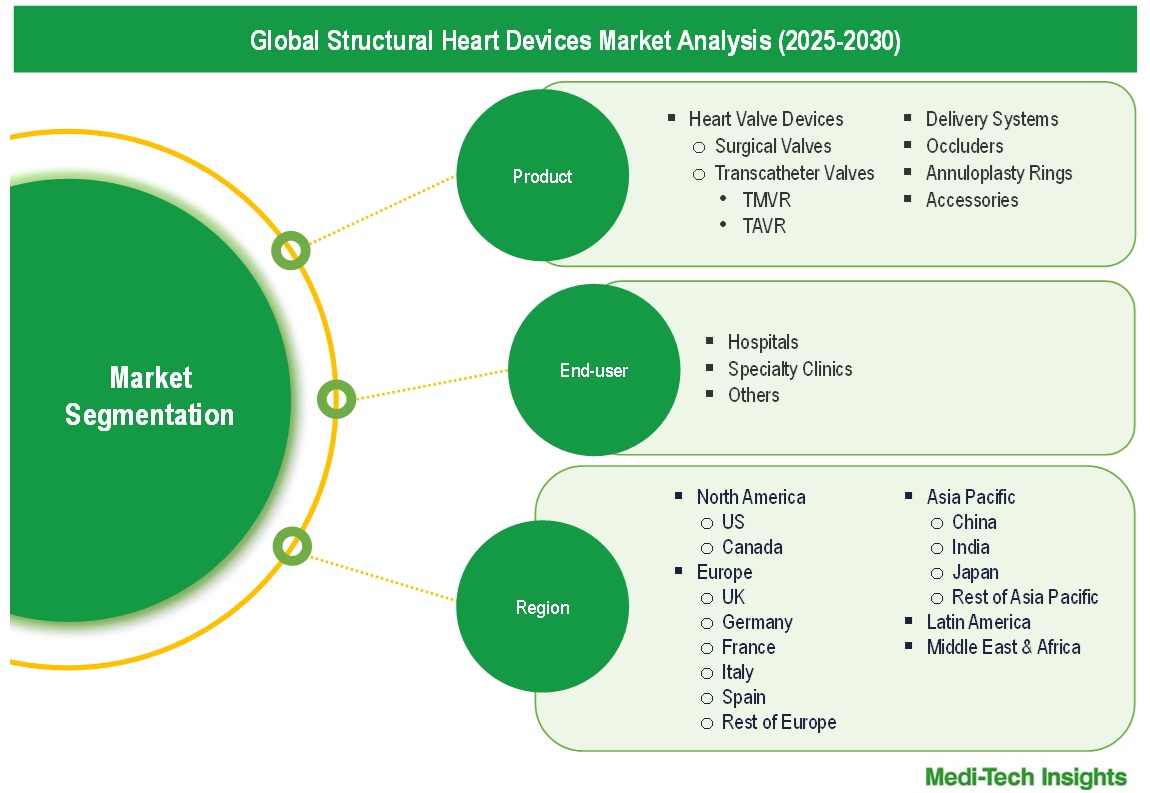
This report by Medi-Tech Insights provides thesize of the global structural heart devices market at theregional- and country-level from 2023 to 2030. The report further segments the market based on product and end-user.
Market Size & Forecast (2023-2030), By Product, USD Million
- Heart Valve Devices
- Surgical Valves
- Transcatheter Valves
- Transcatheter Aortic Valve Replacement (TAVR)
- Transcatheter Mitral Valve Replacement (TMVR)
- Delivery Systems
- Occluders
- Annuloplasty Rings
- Accessories
Market Size & Forecast (2023-2030), By End-user, USD Million
- Hospitals
- Specialty Clinics
- Others
- North America
- US
- Canada
- Europe
- UK
- Germany
- France
- Italy
- Spain
- Rest of Europe
- Asia Pacific
- China
- India
- Japan
- Rest of Asia Pacific
- Latin America
- Middle East & Africa
- What is the market size & forecast of the structural heart devices market?
- What are historical, present, and forecasted market shares and growth rates of various segments and sub-segments of the structural heart devices market?
- What are the key trends defining the market?
- What are the major factors impacting the market?
- What are the opportunities prevailing in the market?
- Which region has the highest share in the global market? Which region is expected to witness the highest growth rate in the next 5 years?
- Who are the major players operating in the market?
- What are the key strategies adopted by players?
Key Strategic Questions Addressed
Need a More Tailored Analysis?
- Discuss the market sizing methodology and forecast assumptions with our healthcare analysts.
- Expand the scope with additional countries, market segments, technologies, or competitor profiling.
- Use the insights to support strategic planning, market entry, commercial due diligence, and long-term revenue growth initiatives.