

Global Artificial Intelligence (AI) in Remote Patient Monitoring (RPM) Market Size, Share, Growth & Trends Report Segmented by Component (Devices, Software, Services), Application (Cardiovascular, Mental Health, Diabetes, Respiratory), End User (Hospitals/Clinics, ASCs) & Regional Forecast to 2031
The global Artificial Intelligence in Remote Patient Monitoring Market size is set to witness a growth rate of 27% in the next 5 years. Rising chronic disease burden and aging population, shift toward proactive and value-based healthcare, telehealth and digital transformation, and integration of wearables and connected medical devices are some of the key factors driving the AI in RPM market. To learn more about the research report, download a sample report.
Artificial Intelligence (AI) in Remote Patient Monitoring (RPM) refers to a set of technology, platforms, devices, and services that use AI algorithms in combination with remote health monitoring systems to monitor, analyze and interpret patient health status over time, and outside traditional clinical environments. The RPM using AI has products such as AI-enabled wearables, connected medical devices, cloud-based data analytics platforms, and others that can be used to identify anomalies, predict patient health deterioration, and provide timely interventions. Using machine learning (ML), predictive analytics, and automation, AI RPM solutions can also improve chronic disease management, decrease hospitalization rates, enhance care coordination, and facilitate value-based care across home and outpatient environments.
Shift toward proactive and value-based healthcare to propel market demand
The shift toward proactive and value-based healthcare is a primary driver of the AI in RPM market. Traditional healthcare systems have largely operated on a fee-for-service basis, meaning that the amount of money received is dependent on how many services were rendered rather than the results achieved by those services. On the other hand, the foundation of value-based care is built on measuring the outcomes associated with each service, improving quality, improving efficiency, increasing preventive measures; and improving the measurable results of overall health back to the patient. To implement this new approach, continuous oversight of patients, identifying potential risks before they occur, and making decisions based on the objective analysis of data collected, are the three requirements which are inherent to the capabilities of AI-enabled RPM technologies.
Under value-based care models, providers are financially incentivized to reduce hospital readmissions, emergency visits, and complications related to chronic diseases. Using AI technologies, RPM systems can continuously collect and analyze real-time data from patients such as heart rate, blood glucose level, blood pressure, oxygen saturation level, and patterns of activity. Advanced algorithms also can detect slight changes in a patient's baseline health data and generate alerts to predict when an event may occur before it actually does, thus enabling healthcare providers to intervene early enough to prevent events from becoming costly acute events and achieving better long-term outcomes, therefore, meeting the key metrics identified in value-based reimbursement models.
Proactive care also shifts the focus from episodic treatment to continuous health management. AI enhances remote patient monitoring platforms by converting large quantities of patient-generated health data into clinically useful insights. Predictive risk scores, automated triage, and tailored care recommendations enable clinicians to focus on delivering resources to high-risk patients first. That has the dual benefits of reducing the amount of time clinicians need for many patients and increasing the quality of care provided to these same patients through better coordinated care among multidisciplinary teams. In addition, more and more value-based care is being delivered outside the hospitals and into homes and communities. The use of RPM by artificial intelligence supports the decentralization of care for chronic disease patients, patients recovering from surgery, and elderly populations with multiple comorbidities. By facilitating care at home, providers can reduce their operational costs while delivering high-quality care.
Payers and health systems are also recognizing the economic benefits of proactive monitoring. Reduced hospitalizations, shorter lengths of stay, and improved medication adherence translate into measurable cost savings. As reimbursement structures evolve to reward preventive care and outcome optimization, healthcare organizations are investing more aggressively in AI-enabled RPM infrastructure.
In summary, the shift towards proactive, value-based care is accelerating adoption of AI technology in RPM by healthcare organizations as it aligns financial incentives with technologies that lead to better outcomes, efficiencies, and continuous patient engagement.

To learn more about this report, download the PDF brochure
Wearables and connected medical devices integration is driving the market growth
Wearables and connected medical devices are a major factor in the growth of AI in RPM, as these devices like smartwatches, biosensors, continuous glucose monitors, smart blood pressure cuffs, pulse oximeters, ECG patches, and implantable cardiac monitors, allow for continuous and real-time collection of physiological data outside of the clinic. Patient-generated real-time health data provides the foundation for AI algorithms to create clinically useful insight from raw metrics.
Connected devices provide longitudinal data ranging from days to weeks or months of health data versus the periodic in-clinic measurements. AI models use the high frequency of health data to identify subtle trends, anomalies, or deviations from each patient’s baseline that might occur over time. For example, gradual change in heart rate variability; sleep pattern; or glucose levels may indicate early deterioration. By identifying these patterns prior to the onset of severe symptoms, AI-based RPM systems will facilitate timely intervention that reduces hospitalizations and improves patient outcomes.
In addition, as wearable technologies become more accessible, user-friendly, and accurate, consumers are increasingly adopting them for daily use, thus expanding the addressable market. Integration with cloud-based platforms and mobile apps allows for real-time transmission of data from the patient to the healthcare provider. This interoperability strengthens care continuity and supports decentralized healthcare delivery models. Advancements made in sensor technology & miniaturization have increased the accuracy & reliability of devices used to collect remote patient data, which allow clinical teams to be more confident in the data collected remotely from patients. In addition to increasing confidence, some medical devices have received regulatory approval for use with chronic disease management, post-acute monitoring, & pre-emptive care increasing the legitimacy of the use of these connected medical devices.
AI is also increasing the overall value of the connected medical devices by allowing for the automation of interpreting patient data & removing many of the false alarms that exist now in today's system; therefore, decreasing the overall workload of clinicians through prioritizing the clinically significant alerts. From a health system prospective, the ability to integrate connected medical devices into the health system allows large patient populations to be monitored efficiently through scalable remote monitoring programs. The ability to aggregate data from various types of devices will also allow for multimodal analysis and will improve predictive accuracy. The continuous expansion of interoperable devices, coupled with the development of intelligent, AI-powered RPM platforms will provide health systems with increasingly comprehensive, intelligent RPM solutions.
The result of integrating wearables and connected medical devices will drive the growth of the AI in the RPM market through continued generation of data, enhanced predictive capability, facilitation of home-based care, and support for creating scalable, technology-based health care delivery solutions.
Growth strategies adopted by players to establish their foothold in the market
Players operating in this market are adopting various growth strategies such as investments, and strategic partnerships and collaborations to garner market share. For instance,
- In September 2025, Philips and Masimo extended their multi-year partnership to accelerate adoption of advanced wearable sensors and AI-powered patient monitoring technologies across bedside and remote care settings. The renewed alliance integrates Masimo’s Radius PPG wearable and co-develops AI algorithms to enhance clinical decision-making, expand device interoperability, and strengthen competitiveness in connected care markets
- In July 2024, Octagos Health secured over US$43 million in Series B funding led by Morgan Stanley Expansion Capital to expand its AI-driven cardiac device monitoring platform. The investment will accelerate growth of its Atlas AI technology, enhance EHR integration, scale operations, and broaden monitoring across pacemakers, defibrillators, ambulatory devices, and consumer wearables
- In June 2024, Anumana and InfoBionic.Ai announced a joint research collaboration to integrate AI-powered ECG algorithms into remote cardiac telemetry for earlier detection of heart diseases. The partnership combines Anumana’s FDA-cleared ECG-AI technology with InfoBionic.Ai’s MoMe ARC platform to enhance continuous remote cardiac monitoring, enable early intervention, and support regulatory clearance of next-generation AI-driven cardiac care solutions
- In August 2023, Zephyr AI and KangarooHealth announced a multi-year strategic partnership to integrate AI and machine learning with remote patient monitoring data to predict and prevent adverse outcomes in chronic disease patients. The collaboration combines Zephyr’s predictive algorithms with KangarooHealth’s AI-assisted RPM platform and connected device network to enhance clinical decision-making and enable earlier, personalized interventions

To learn more about this report, download the PDF brochure
Component Segment Outlook
The AI in RPM market is led by the device segment, which makes up the largest segment, as they form the foundation of RPM programs. Additionally, connected medical devices like wearable sensors, blood pressure cuffs, glucose meters, monitor telemetry systems/rhythm monitors, pulse oximeters, create real-time physiological data which is the foundation of AI for analysis and clinical decision-making. Their rapid adoption as part of chronic disease management programs is expected to add considerable revenues to the RPM market. At the same time, the software segment is growing the fastest and is primarily driven by both the increasing demand for AI-enabled analytics programs, predictive analysis algorithms, cloud-based dashboards and interoperability solutions that help to convert raw patient data into usable clinical information and automated care delivery pathways.
Regional Outlook: North America expected to hold a major share in the AI in RPM market
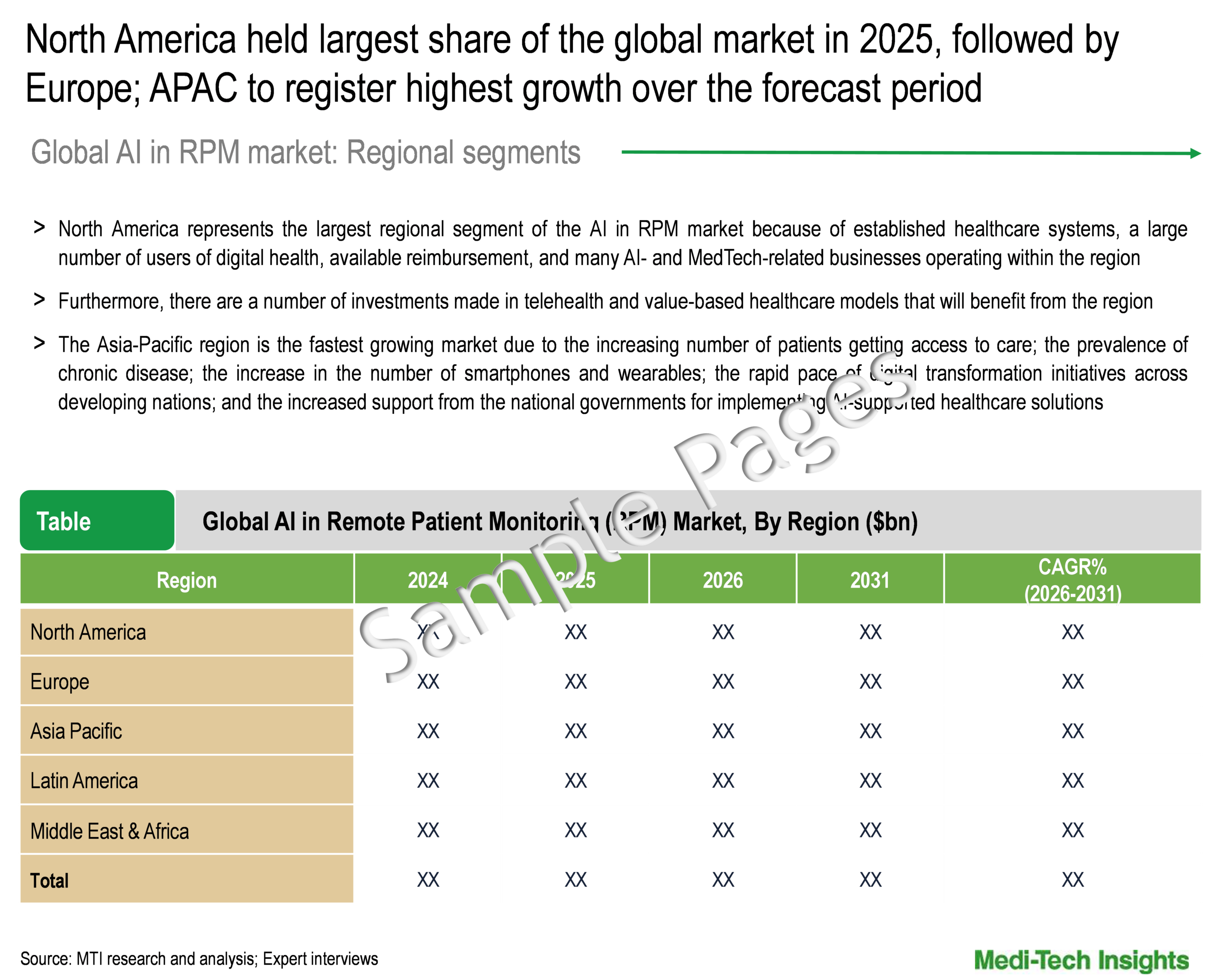
North America represents the largest regional segment of the AI in RPM market owing to established healthcare systems, a large number of users of digital health, available reimbursement, and many AI- and MedTech-related businesses operating within the region. Furthermore, there are a number of investments made in telehealth and value-based healthcare models that will benefit from the region. The Asia-Pacific region is the fastest growing market due to the increasing number of patients getting access to care; the prevalence of chronic disease; the increase in the number of smartphones and wearables; the rapid pace of digital transformation initiatives across developing nations; and the increased support from the national governments for implementing AI-supported healthcare solutions.
Competitive Landscape Analysis
The global AI in RPM market is marked by the presence of established and emerging market players such as Medtronic plc (Ireland); Koninklijke Philips N.V. (The Netherlands); GE HealthCare (US); Boston Scientific Corporation (US); Masimo Corporation (US); ResMed (US); Dexcom, Inc. (US); AliveCor, Inc. (US); HealthSnap, Inc. (US); and Biofourmis (US); among others. Some of the key strategies adopted by market players include investments, and strategic partnerships and collaborations to garner market share.

Get a sample report for competitive landscape analysis
Report Scope
|
Report Metric |
Details |
|
Base Year Considered |
2025 |
|
Historical Data |
2024 – 2025 |
|
Forecast Period |
2026 – 2031 |
|
Growth Rate |
27% |
|
Segment Scope |
Product, Application, End User |
|
Regional Scope |
|
|
Market Drivers |
|
|
Attractive Opportunities |
|
|
Key Companies Mapped |
Medtronic plc (Ireland); Koninklijke Philips N.V. (The Netherlands); GE HealthCare (US); Boston Scientific Corporation (US); Masimo Corporation (US); ResMed (US); Dexcom, Inc. (US); AliveCor, Inc. (US); HealthSnap, Inc. (US); and Biofourmis (US); among others |
|
Report Highlights |
Market Size & Forecast, Growth Drivers & Restraints, Trends, Competitive Analysis |
Global AI in RPM Market Segmentation
This report by Medi-Tech Insights provides the size of the global AI in RPM market at the regional- and country-level from 2024 to 2031. The report further segments the market based on product, application, and end user.
Market Size & Forecast (2024-2031), By Product, USD Billion
- Devices
- Wearable Devices
- Implantable Devices
- Handheld & Portable Devices
- Stationary Devices
- Software
- Services
Market Size & Forecast (2024-2031), By Application, USD Billion
- Cardiovascular Monitoring
- Mental Health & Behavioural Monitoring
- Diabetes Management
- Respiratory Monitoring
- Oncology Remote Monitoring
- Post-operative & Home Recovery
- Other Applications
Market Size & Forecast (2024-2031), By End User, USD Billion
- Hospitals and Clinics
- Ambulatory Surgery Centers (ASCs)
- Other End Users
Market Size & Forecast (2024-2031), By Region, USD Billion
- North America
- US
- Canada
- Europe
- UK
- Germany
- France
- Italy
- Spain
- Rest of Europe
- Asia Pacific
- China
- India
- Japan
- Rest of Asia Pacific
- Latin America
- Middle East & Africa
Related Reports:
- Introduction
- Introduction
- Market Scope
- Market Definition
- Segments Covered
- Regional Segmentation
- Research Timeframe
- Currency Considered
- Study Limitations
- Stakeholders
- List of Abbreviations
- Key Conferences and Events (2026-2027)
- Research Methodology
- Secondary Research
- Primary Research
- Market Estimation
- Bottom-Up Approach
- Top-Down Approach
- Market Forecasting
- Executive Summary
- Artificial Intelligence (AI) in Remote Patient Monitoring (RPM) Market Snapshot (2026-2031)
- Segment Overview
- Regional Snapshot
- Competitive Insights
- Market Overview
- Market Dynamics
- Drivers
- Rising chronic disease burden and aging population
- Shift toward proactive and value-based healthcare
- Telehealth and digital transformation
- Wearables and connected medical devices integration
- Restraints
- Data privacy and security concerns
- Implementation and integration complexity
- High costs and expertise gaps
- Patient adoption barriers
- Opportunities
- Expansion in emerging markets
- Telehealth and home healthcare growth
- Personalized and predictive care
- Integration with broader digital health ecosystems
- Key Market Trends
- Multimodal AI
- Edge AI and localized processing
- Generative AI for patient engagement
- Unmet Market Needs
- Industry Speaks
- Drivers
- Market Dynamics
- Global Artificial Intelligence (AI) in Remote Patient Monitoring (RPM) Market Size & Forecast (2024-2031), By Component, USD Billion
- Introduction
- Devices
- Wearable Devices
- Implantable Devices
- Handheld & Portable Devices
- Stationary Devices
- Software
- Services
- Global Artificial Intelligence (AI) in Remote Patient Monitoring (RPM) Market Size & Forecast (2024-2031), By Application, USD Billion
- Introduction
- Cardiovascular Monitoring
- Mental Health & Behavioural Monitoring
- Diabetes Management
- Respiratory Monitoring
- Oncology Remote Monitoring
- Post-operative & Home Recovery
- Other Applications
- Global Artificial Intelligence (AI) in Remote Patient Monitoring (RPM) Market Size & Forecast (2024-2031), By End User, USD Billion
- Introduction
- Hospitals and Clinics
- Ambulatory Surgery Centers (ASCs)
- Other End Users
- Global Artificial Intelligence (AI) in Remote Patient Monitoring (RPM) Market Size & Forecast (2024-2031), By Region, USD Billion
- Introduction
- North America Artificial Intelligence (AI) in Remote Patient Monitoring (RPM) Market Size & Forecast (2024-2031), By Country, USD Billion
- US
- Market Size & Forecast, By Component, (USD Billion)
- Market Size & Forecast, By Application (USD Billion)
- Market Size & Forecast, By End User (USD Billion)
- Canada
- Market Size & Forecast, By Component, (USD Billion)
- Market Size & Forecast, By Application (USD Billion)
- Market Size & Forecast, By End User (USD Billion)
- US
- Europe Artificial Intelligence (AI) in Remote Patient Monitoring (RPM) Market Size & Forecast (2024-2031), By Country, USD Billion
- UK
- Market Size & Forecast, By Component, (USD Billion)
- Market Size & Forecast, By Application (USD Billion)
- Market Size & Forecast, By End User (USD Billion)
- Germany
- Market Size & Forecast, By Component, (USD Billion)
- Market Size & Forecast, By Application (USD Billion)
- Market Size & Forecast, By End User (USD Billion)
- France
- Market Size & Forecast, By Component, (USD Billion)
- Market Size & Forecast, By Application (USD Billion)
- Market Size & Forecast, By End User (USD Billion)
- Italy
- Market Size & Forecast, By Component, (USD Billion)
- Market Size & Forecast, By Application (USD Billion)
- Market Size & Forecast, By End User (USD Billion)
- Spain
- Market Size & Forecast, By Component, (USD Billion)
- Market Size & Forecast, By Application (USD Billion)
- Market Size & Forecast, By End User (USD Billion)
- Rest of Europe
- Market Size & Forecast, By Component, (USD Billion)
- Market Size & Forecast, By Application (USD Billion)
- Market Size & Forecast, By End User (USD Billion)
- UK
- Asia Pacific (APAC) Artificial Intelligence (AI) in Remote Patient Monitoring (RPM) Market Size & Forecast (2024-2031), By Country, USD Billion
- China
- Market Size & Forecast, By Component, (USD Billion)
- Market Size & Forecast, By Application (USD Billion)
- Market Size & Forecast, By End User (USD Billion)
- Japan
- Market Size & Forecast, By Component, (USD Billion)
- Market Size & Forecast, By Application (USD Billion)
- Market Size & Forecast, By End User (USD Billion)
- India
- Market Size & Forecast, By Component, (USD Billion)
- Market Size & Forecast, By Application (USD Billion)
- Market Size & Forecast, By End User (USD Billion)
- Rest of Asia Pacific
- Market Size & Forecast, By Component, (USD Billion)
- Market Size & Forecast, By Application (USD Billion)
- Market Size & Forecast, By End User (USD Billion)
- China
- Latin America (LATAM) Artificial Intelligence (AI) in Remote Patient Monitoring (RPM) Market Size & Forecast (2024-2031), USD Billion
- Market Size & Forecast, By Component, (USD Billion)
- Market Size & Forecast, By Application (USD Billion)
- Market Size & Forecast, By End User (USD Billion)
- Middle East & Africa (MEA) Artificial Intelligence (AI) in Remote Patient Monitoring (RPM) Market Size & Forecast (2024-2031), USD Billion
- Market Size & Forecast, By Component, (USD Billion)
- Market Size & Forecast, By Application (USD Billion)
- Market Size & Forecast, By End User (USD Billion)
- Competitive Landscape
- Key Players and their Competitive Positioning
- Key Player Comparison
- Segment-wise Player Mapping
- Market Share Analysis (2025)
- Company Categorization Matrix
- Dominants/Leaders
- New Entrants
- Emerging Players
- Innovative Players
- Key Strategies Assessment, By Player (2023-2026)
- New Product and Service Launches
- Partnerships, Agreements, & Collaborations
- Mergers & Acquisitions
- Geographic Expansion
- Key Players and their Competitive Positioning
- Company Profiles*
(Business Overview, Financial Performance**, Products Offered, Recent Developments)
- Medtronic plc
- Koninklijke Philips N.V.
- GE HealthCare
- Boston Scientific Corporation
- Masimo Corporation
- Resmed
- Dexcom, Inc.
- AliveCor, Inc.
- HealthSnap, Inc.
- Biofourmis
- Other Prominent Players
Note: *Indicative list
**For listed companies
The study has been compiled based on extensive primary and secondary research.
Secondary Research (Indicative List)

Primary Research
To validate research findings (market size & forecasts, market segmentation, market dynamics, competitive landscape, key industry trends, etc.), extensive primary interviews were conducted with both supply and demand-side stakeholders.
Supply Side Stakeholders:
- Senior Management Level: CEOs, Presidents, Vice-Presidents, Directors, Chief Technology Officers, Chief Commercial Officers
- Mid-Management Level: Product Managers, Sales Managers, Brand Managers, R&D Managers, Business Development Managers, Consultants
Demand Side Stakeholders:
- Hospitals and Clinics, Ambulatory Surgery Centers (ASCs), and others
Breakdown of Primary Interviews

Market Size Estimation
Both ‘Top-Down & Bottom-Up Approaches’ were used to derive market size estimates and forecasts
Data Triangulation
Research findings derived through secondary sources & internal analysis was validated with Primary Interviews, Internal Knowledge Repository and Company’s Sales Data


Features of the Report
- Comprehensive Market Coverage
- Market Size and Forecast
- Geographic & Segment Deep Dives
- Strategic Insights & Competitive Landscape
- Timely & Updated Data
- Growth Indicators & Future Outlook
- Quick Turnaround on Queries
- Analyst Support
- Report Customization Available
- Reports in PDF & Excel
