Download FREE Sample


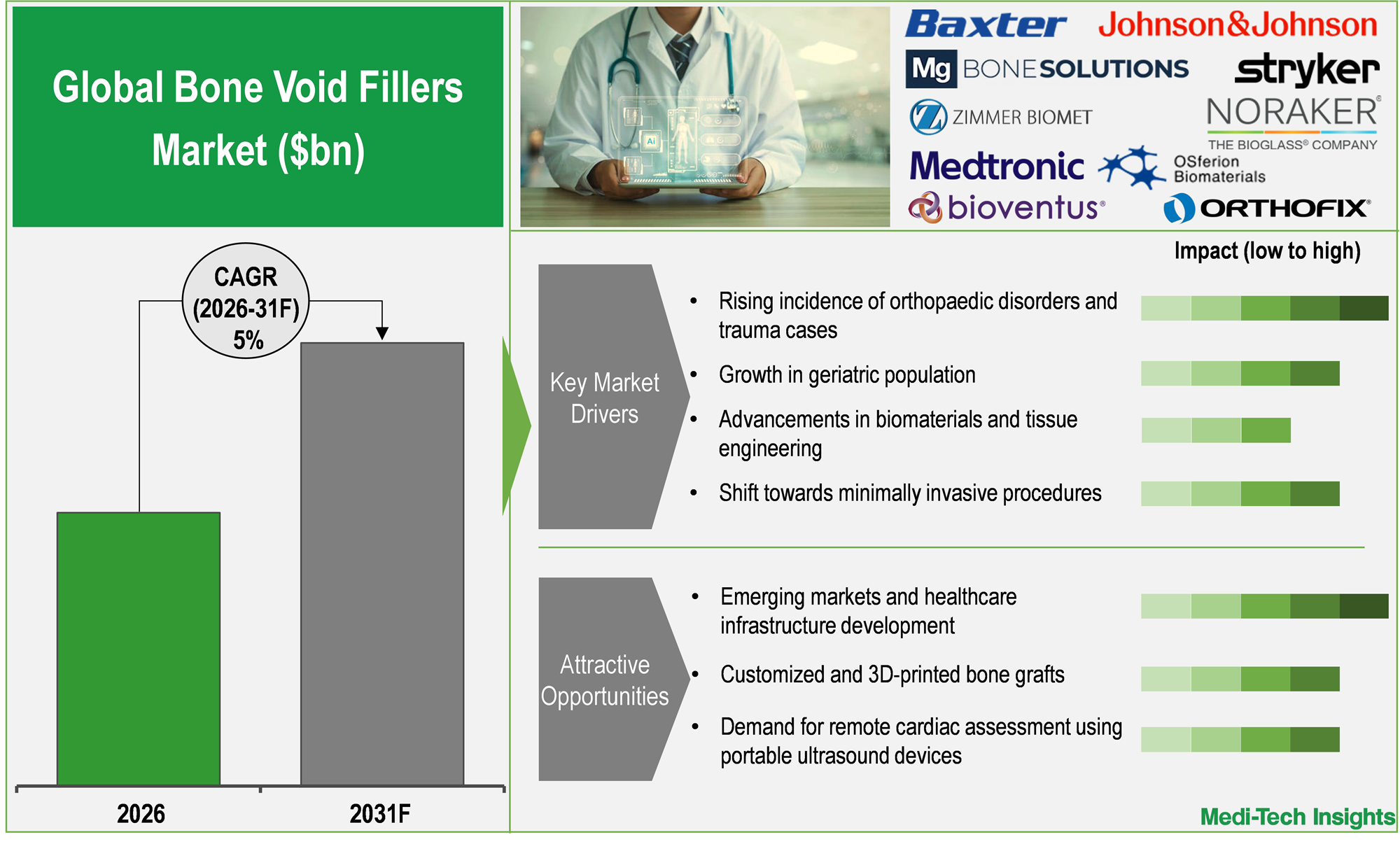
The global bone void fillers market size is set to
grow at 5% CAGR over the next 5 years. Rising incidence of orthopedic
disorders and trauma cases, growth in geriatric population, advancements in
biomaterials and tissue engineering, increasing number of spinal and joint
replacement surgeries, shift towards minimally invasive procedures, and shortage
and limitations of autografts/allografts are some of the key factors driving
the growth of the global market. However, high cost of advanced bone void
fillers, stringent regulatory approval processes, and limited osteoinductive
capabilities are expected to impact the market’s growth.
Bone void fillers (BVFs) are biocompatible materials used to fill gaps or defects in bones resulting from trauma, surgery, disease, or congenital conditions. These fillers provide structural support and promote new bone growth by serving as scaffolds for osteogenesis. They are commonly used in orthopedic, spinal, dental, and trauma surgeries when natural bone grafts like autografts or allografts are not viable. BVFs can be made from various materials including synthetic substances like calcium phosphate, hydroxyapatite, allografts, or bioactive compounds. Their key advantages include reduced donor site morbidity, consistent availability, and the potential for customization to match patient-specific needs.
To learn more about this report, download the PDF brochure
Rising incidence of orthopedic disorders and trauma cases to propel market demand
The rising incidence of orthopedic disorders and trauma
cases is significantly driving demand for bone void fillers (BVFs), as these
conditions frequently result in bone defects requiring surgical reconstruction
and effective bone-healing solutions. Conditions such as osteoporosis,
osteoarthritis, bone tumours, and degenerative bone diseases, along with
fractures caused by road accidents, workplace injuries, and sports-relatedtrauma, contribute to the growing volume of orthopedic and trauma
procedures. According to The Lancet, approximately 494 million people worldwide
were affected by musculoskeletal disorders in 2020, with this number projected
to increase by 115% to approximately 1.06 billion by 2050. The growing burden
of these conditions is expected to increase the number of surgical
interventions involving bone repair and reconstruction.
BVFs are increasingly utilized to fill osseous defects,
provide structural support, facilitate new bone formation, and promote defect
healing across orthopedic,
trauma, and spinal procedures. Their availability in various forms, including
demineralized bone matrix, calcium-based materials, collagen matrices, and synthetic graft substitutes, enables
clinicians to select products based on defect characteristics and procedural
requirements. Furthermore, BVFs can supplement or serve as alternatives to
autologous bone grafts, potentially reducing complications associated with
graft harvesting. Consequently, increasing orthopedic disease prevalence,
rising trauma burden, and expanding surgical treatment volumes are expected to
sustain demand for BVFs globally.
Advancements in biomaterials and tissue engineering are driving the market growth
Advancements in biomaterials and tissueengineering are key drivers of growth in the bone
void fillers (BVFs) market, enabling the development of products with improved
biocompatibility, osteoconductivity, resorption characteristics, and mechanical
performance. Innovations in synthetic materials such as calcium phosphate,
hydroxyapatite, tricalcium phosphate, and bioactive glass are allowing
manufacturers to develop fillers that more closely replicate the composition
and functional characteristics of natural bone. These materials can provide
structural support while gradually resorbing and facilitating new bone
formation, making them suitable for a broad range of orthopedic, trauma, and
spinal procedures.
In parallel, advances in tissue engineering and scaffoldtechnologies are supporting the development of
three-dimensional structures with interconnected porous architectures that
promote cellular infiltration, vascularization, and bone regeneration.
Manufacturers are also exploring composite biomaterials that combine ceramics,
polymers, collagen, and bioactive components to achieve a balance between
mechanical strength and biological performance. Such innovations can improve
handling characteristics and expand the applicability of BVFs to complex or
irregular bone defects. The development of next-generation resorbable and
bioactive fillers is also reducing reliance on traditional autografts in
selected procedures, potentially minimizing donor-site complications. As
clinical evidence and surgeon familiarity with these technologies increase,
adoption of advanced BVFs is expected to expand, supporting market growth
globally.
Customized and 3D-printed bone grafts, a major opportunity
Customized and 3D-printed bone grafts represent a promising opportunity in the bone void fillers market by enabling patient-specific solutions tailored to complex anatomical defects. Advanced 3D printing technologies can produce implants with customized shapes, porous structures, and controlled mechanical properties that support bone ingrowth and integration. These solutions may be particularly valuable in complex trauma, spinal, craniofacial, and revision orthopedic procedures where conventional fillers may not adequately address irregular defects. Growing adoption of digital imaging, computer-aided design, and additive manufacturing is facilitating personalized treatment approaches. Continued advances in biomaterials, combined with improving regulatory pathways and clinical evidence, are expected to create opportunities for wider commercialization of customized bone graft solutions.
To learn more about this report, download the PDF brochure
Type Segment Outlook
Demineralized Bone Matrix (DBM) accounts for the largest
share of the bone void fillers market, supported by its strong osteoinductive
and osteoconductive properties, biocompatibility, and established clinical use
across orthopedic, trauma, and spinal procedures. DBM retains components of the
natural bone matrix that support new bone formation and is available in
convenient forms such as putty, paste, and gel, facilitating application in
irregular defects. Its ability to provide an alternative to autografts while
avoiding donor-site morbidity further supports adoption. Calcium sulfate is
expected to register the fastest growth, driven by its predictable resorption,
biocompatibility, and ability to completely biodegrade following bone
regeneration. Its growing use as an antibiotic carrier in osteomyelitis and
infection-related orthopedic procedures is further increasing demand. Rising
adoption of synthetic bone void fillers and continued product launches are also
supporting segment expansion.
Regional Outlook: North America maintains its leading position in the bone void fillers market
North America accounts for the largest share of the bone
void fillers market, supported by its well-established orthopedic healthcare
infrastructure, high volume of trauma, spinal fusion, joint reconstruction, and
sports injury procedures, and strong adoption of advanced synthetic and
bioactive bone substitutes. The region also benefits from the presence of
leading manufacturers, established reimbursement pathways, and significant
investment in clinical research and product development. Growing use of minimally
invasive orthopedic procedures and surgeon preference for synthetic
alternatives that can avoid complications associated with autograft harvesting
further support demand. The US represents the major contributor to regional
revenues, driven by its large procedural base and rapid adoption of innovative
bone void filler technologies.
Asia Pacific is expected to register the fastest growth,
driven by the increasing volume of orthopedic and trauma surgeries, rapidly
aging populations, rising prevalence of osteoporosis, and expansion of
healthcare infrastructure across China, India, Japan, and other markets.
Growing awareness of bone void filler technologies and increasing adoption of
advanced synthetic products are further supporting market development. In
addition, rising healthcare expenditure, medical tourism, and increasing availability
of specialized orthopedic care are expanding access to procedures requiring
bone graft substitutes. The entry and expansion of manufacturers with
cost-effective products are also expected to improve affordability and
accelerate adoption across emerging APAC markets.
Competitive Landscape Analysis
The global bone void fillers market is marked by the
presence of established and emerging market players such as-
- Medtronic
- Noraker
- Johnson
& Johnson
- Stryker
- Baxter
- Bioventus
- Orthofix
- Bone
Solutions Inc.
- OSferionBiomaterials
Corp.
- Zimmer Biomet

Growth strategies adopted by players to establish their foothold in the bone void fillers market
Players operating in this market are adopting various growth
strategies such as new product launch; acquisitions; expansions; and strategic
partnerships, agreements, and collaborations, to garner market share. For
instance,
- In
June 2026, SDIP Innovations received FDA 510(k) clearance for JAZBI Bone
Void Filler, a resorbable polymer-ceramic bone graft substitute designed
to support tissue infiltration and new bone formation
- In
August 2024, LifeNet Health launched PliaFX Pak in collaboration with
Johnson & Johnson MedTech, a moldable bone allograft combining
mineralized bone chips and demineralized fibers for orthopedic spine and
trauma procedures
- In
November 2024, NovaBone received FDA clearance for expanded use of
NovaBone Putty in the intervertebral disc space, supporting interbody
fusion procedures and broadening applications for synthetic bone void
fillers
- In
April 2023, Abyrx received additional FDA clearances for MONTAGE Settable
Resorbable Bone Putty as a bone void filler and cranial bone cement,
expanding its orthopedic and cranial applications
Report Scope
|
Report Metric |
Details |
|
Base Year Considered |
2025 |
|
Historical Data |
2024 – 2025 |
|
Forecast Period |
2026 – 2031 |
|
Growth Rate |
5% |
|
Segment Scope |
Type, Form, Application, and End User |
|
Regional Scope |
|
|
Market Drivers |
|
|
Attractive Opportunities |
|
|
Key Companies Mapped |
Medtronic; Noraker; Johnson & Johnson; Stryker;
Baxter; Bioventus; Orthofix; Bone Solutions Inc.; OSferionBiomaterials Corp.;
and Zimmer Biomet; among others |
|
Report Highlights |
Market Size & Forecast, Growth Drivers &
Restraints, Trends, Competitive Analysis |
Market Segmentation
This report by Medi-Tech Insights provides the size of
the global bone void fillers market at the regional and country-level from
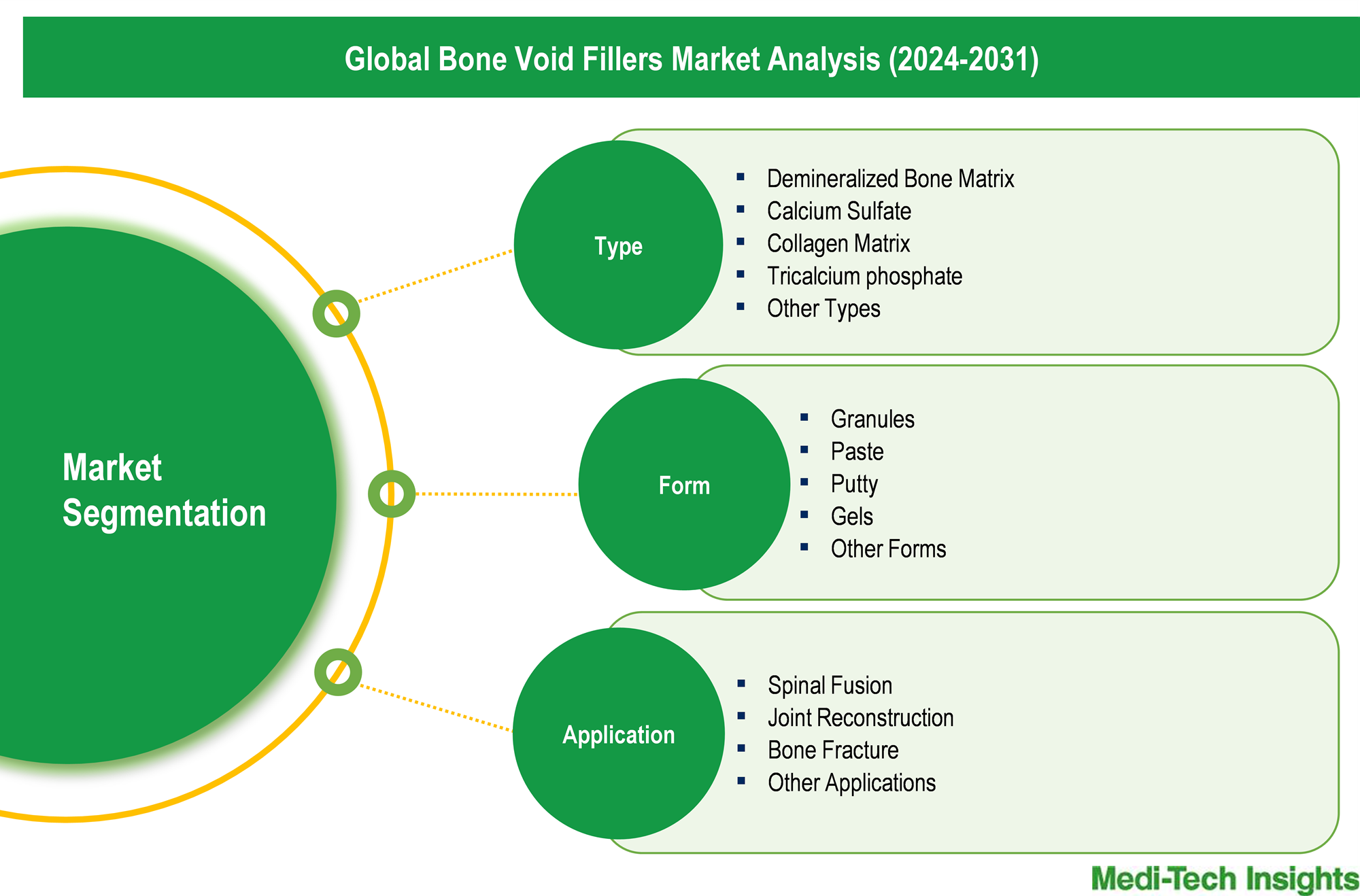
2024 to 2031. The report further segments the market by type, form,
application, and end user.
- Market
Size & Forecast (2024-2031), By Type, USD Billion
- Demineralized
Bone Matrix
- Calcium
Sulfate
- Collagen
Matrix
- Tricalcium
phosphate
- Other
Types
- Market
Size & Forecast (2024-2031), By Form, USD Billion
- Granules
- Paste
- Putty
- Gels
- Other
Forms
- Market
Size & Forecast (2024-2031), By Application, USD Billion
- Spinal
Fusion
- Joint
Reconstruction
- Bone
Fracture
- Other
Applications
- Market
Size & Forecast (2024-2031), By End User, USD Billion
- Hospitals
and Clinics
- Orthopaedic
Centers
- Ambulatory
Surgical Centers (ASCs)
- Other
End Users
- Market
Size & Forecast (2024-2031), By Region, USD Billion
- North
America
- US
- Canada
- Europe
- UK
- Germany
- France
- Italy
- Spain
- Rest
of Europe
- Asia
Pacific
- China
- India
- Japan
- Rest
of Asia Pacific
- Latin
America
- Middle
East & Africa
Frequently Asked Questions About This Report
What is the growth rate of the bone void fillers market?
The bone void fillers market is set to witness a growth rate of 5% during the forecast period from 2026 to 2031
What are the key trends defining the market?
Shift toward synthetic and bioactive materials, rising use of injectable and moldable BVFs, and focus on biodegradable and resorbable fillers are major trends in the bone void fillers market
What are the major factors impacting the market growth?
Rising incidence of orthopedic disorders and trauma cases, growth in geriatric population, advancements in biomaterials and tissue engineering, increasing number of spinal and joint replacement surgeries, shift towards minimally invasive procedures, and shortage and limitations of autografts/allografts are some of the key factors driving the bone void fillers market
What are the opportunities prevailing in the market?
Emerging markets and healthcare infrastructure development, customized and 3D-printed bone grafts, collaborations in R&D and academia, and increasing application in dental and craniofacial surgeries offer numerous growth opportunities for companies operating in the bone void fillers market
Which region has the highest share in the global market? Which region is expected to witness the highest growth rate in the next 5 years?
North America held the largest share of the global bone void fillers market in 2025, while Asia-Pacific is projected to grow at the highest CAGR during the forecast period
Who are the major players operating in the market?
Some of the major players operating in the bone void fillers market include Medtronic; Noraker; Johnson & Johnson; Stryker; Baxter; Bioventus; Orthofix; Bone Solutions Inc.; OSferionBiomaterials Corp.; and Zimmer Biomet; among others
Need a More Tailored Analysis?
- Discuss the market sizing methodology and forecast assumptions with our healthcare analysts.
- Expand the scope with additional countries, market segments, technologies, or competitor profiling.
- Use the insights to support strategic planning, market entry, commercial due diligence, and long-term revenue growth initiatives.