Download FREE Sample


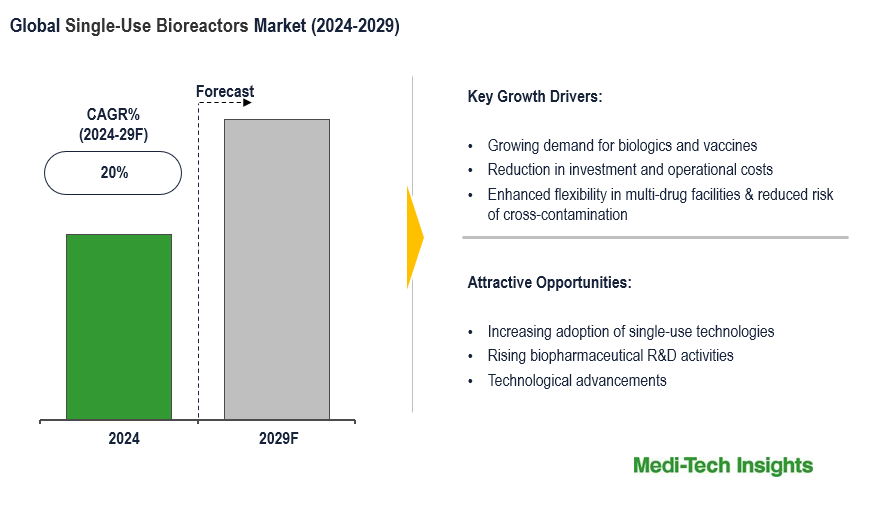
The Global Single-use Bioreactors Market is set to witness a healthy growth rate of 20% by 2029. Technological innovations such as the launch of large-scale single-use bioreactors, demand from pharmaceutical companies, CROs & CDMOs, growing biologics market, increasing biopharmaceutical R&D, and benefits of single-use bioreactors are some of the key factors driving the market growth.
Due to their Ability to Enhance Flexibility, Reduce Investment & Limit Operational Costs, Single-use Bioreactors Have Become Established in Modern Biopharmaceutical Processes Enhanced flexibility is one of the biggest benefits of single-use bioreactors. There is a growing trend towards multi-drug facilities, which warrants the production of different drugs using the same facility with minimum time & cost and top-notch quality. In such scenarios, one of the key manufacturing challenges is line clearance and validation of cleaning to ensure there is no carry-over from earlier batches. Downtime limits the number of batches produced in a given period. Single-use bioreactors significantly reduce the time spent preparing the bioreactor for the subsequent batch. A line changeover with a stainless-steel bioreactor can take ~6 to 10 hours and three weeks for a full product changeover while by using single-use bioreactors it is likely to take 2 hours for line changeover. If the manufacturing line is composed of all single-use components such as bags, filters, and connectors, the total time for product changeover can be 48 hours. Single-use bioreactors possess the capability to reduce downtime from two to three weeks to 48 hours, which in turn can significantly impact a company's output. Some of the other key advantages of using single-use bioreactors are: To learn more about this report, download the PDF brochure Generally, drug development research, process development, and scale-up activities are performed by highly qualified and trained personnel. These individuals are involved in every stage of a study from early-stage research through to benchtop manufacturing. With stainless steel or glass benchtop bioreactors, individual components need to be cleaned, assembled, leak-tested, sterilized, and cooled before every trial batch is taken. However, the use of single-use bioreactors almost eliminates these steps, which allows scientists more time to focus on their developmental studies. Commercially available single-use bioreactors are robust and provide the high performanceecessary for commercial manufacturing of biopharmaceuticals. Significant advancements in bioreactor design, film technologies, stirring mechanisms, and sensor systems have contributed to the increasing adoption of single-use bioreactors from the lab to the production scale. To cater to the changing needs of the customers such as next-generation cell- and gene-therapies and continuous bioprocessing, suppliers of single-use bioreactors often work closely with its customers, which in turn is expected to fuel the demand for single-use bioreactors. The uptake of single-use bioreactors is mainly driven by the activity of the different regions regarding the development of new disease treatments and biosimilars. In addition, existing production capacity comes into play and company strategies regarding the manufacture of clinical material. As the USA is indeed leading in the field of developing innovative treatments, we see a strong uptake of single-use bioreactors, but Europe and Asiare not far behind. -CEO, Leading Manufacturer of Single-use Bioreactors, United States Traditionally, single-use bioreactors were restricted in size due to pressure challenges from the increased weight of the liquid medium in larger volume bags with 2,000 L being the upper limit. Therefore, if bio manufacturers required larger volumes, they had to run several systems in unison or opt for stainless-steel tanks. However, in the last few years, considering strong demand from pharmaceutical companies and contract development and manufacturing organizations (CDMOs), several single-use bioreactor manufacturers have launched large-scale single-use bioreactors which are expected to fuel the market growth in the coming years. Aligned with this trend, To learn more about this report, download the PDF brochure The stirred-tank single-use bioreactors dominate the single-use bioreactors market. They are commonly employed for culturing biological agents such as cells, enzymes, or antibodies, and GMP production of monoclonal antibodies (MAb) therapeutics and other biological. Stirred-tank single-use bioreactors are mainly used to scale up a process from the research and development scale to the manufacturing scale. Available sizes range from 15 mL to 2000 L for single-use and larger than 2000 L for stainless steel. The benefits of good fluid mixing and oxygen transferability, easy scale-up, low operating costs, compliance with current good manufacturing practice requirements, good temperature control, and alternative impellers are some of the key factors bolstering its demand. Single-use bioprocessing solutions, including Single-use Bioreactor Systems, Single-use Media Bags, and Single-use Filtration Assemblies, are revolutionizing the pharmaceutical industry. Dominating this segment, Single-use Bioreactor Systems replace traditional stainless steel or glass vessels with disposable bags, enhancing flexibility, reducing capital investment, and lowering operational costs. These systems are widely used for cell harvesting, media preparation, and virus inactivation due to their scalability and efficiency. Complementing these bioreactor systems, Single-use Media Bags provide scalable and pre-sterilized options that minimize cross-contamination risks and eliminate cleaning validation needs, ensuring process integrity. Additionally, Single-use Filtration Assemblies offer ready-to-use, pre-sterilized solutions for purification and filtration, streamlining operations and meeting stringent GMP standards. Together, these single-use components enable a flexible, cost-effective, and efficient approach to biopharmaceutical manufacturing. Some of the key players operating in the market are Sartorius Stedim Biotech, Thermo Fisher Scientific, Danaher Corporation, Merck KGaA, Celltainer Biotech BV, Getinge AB, Eppendorf AG, Cellexus, PBS Biotech Inc., ABEC, Able Corporation & Biott Corporation, G&G Technologies Inc., Solida Biotech GmbH, and Satake Chemical Equipment Mfg among others. Get a sample report for competitive landscape analysis Players operating in this market are adopting both organic and inorganic growth strategies such as collaborations, acquisitions, and new product launches to garner market share. For instance, The market is expected to gain further momentum in the coming years due to technological advancements, rising R&D investments, new product launches, and aggressive organic and inorganic growth strategies followed by the players.
Potential Time Savings for Highly Trained Personnel Another Key Benefit of Single-use Bioreactors
Technological Advancements & Customer-Centric Approach A Key Factor Bolstering the Demand of Single-use Bioreactors
Introduction of Large-Scale Single-use Bioreactors Set to Drive the Market
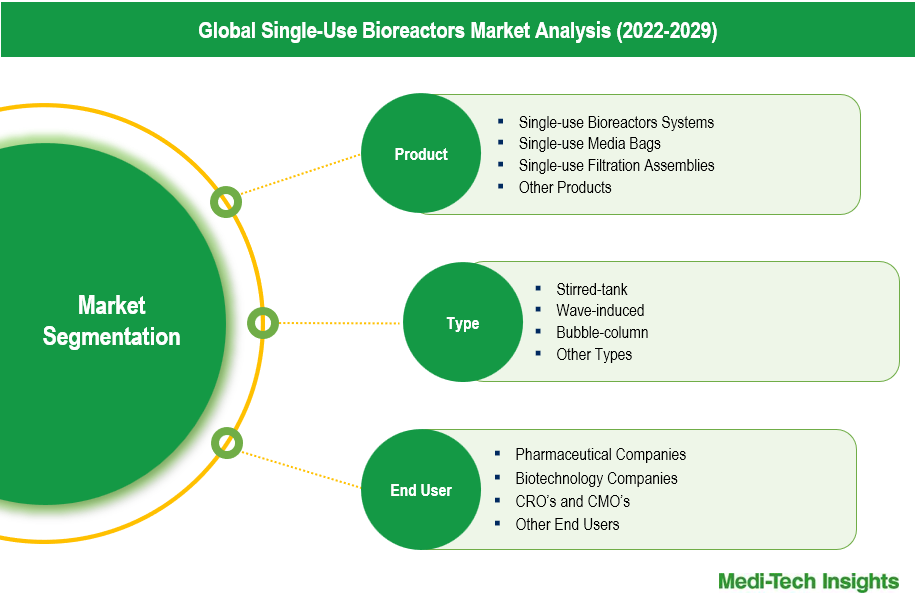
Stirred-tank Single-use Bioreactors Accounts for the Largest Share in the Single-use Bioreactors Market
Single-use Bioreactor Systems: Pioneering Flexibility and Cost-Reduction in Bioprocessing
Competitive Landscape Analysis
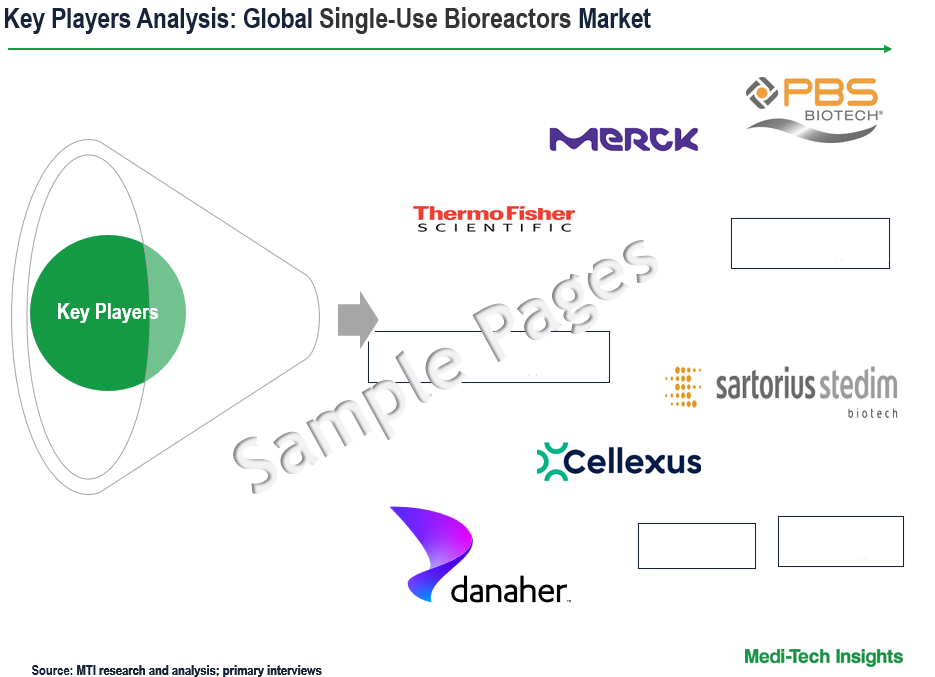
Organic and Inorganic Growth Strategies Adopted by Players to Establish Their Foothold in the Market
Single-Use Bioreactors Market Report Scope
Report Scope
Details
Base Year Considered
2023
Historical Data
2022 - 2023
Forecast Period
2024 - 2029
CAGR (2024-2029)
20%
Segment Scope
Product, Type, Cell, Molecule, Application, and End User
Regional Scope
Key Companies Mapped
Sartorius Stedim Biotech, Thermo Fisher Scientific, Danaher Corporation, Merck KGaA, Celltainer Biotech BV, Getinge AB, Eppendorf AG, Cellexus, PBS Biotech Inc., ABEC, Able Corporation & Biott Corporation, G&G Technologies Inc., Solida Biotech GmbH, and Satake Chemical Equipment Mfg among others
Report Highlights
Market Size & Forecast, Growth Drivers & Restraints, Trends, Competitive Analysis
Key Strategic Questions Addressed
What is the market size & forecast for the Global Single-Use Bioreactors Market?
What are the historical, present, and forecasted market shares and growth rates of various segments and sub-segments of the Global Single-Use Bioreactors Market?
How has COVID-19 impacted the Global Single-Use Bioreactors Market?
What are the major growth drivers, restraints/challenges impacting the market?
What are the opportunities prevailing in the market?
What is the investment landscape?
Which region has the highest share in the global market? Which region is expected to witness the highest growth rate in the next 5 years?
Who are the major players operating in the market? What is he competitive positioning of key players?
Who are the new players entering the market?
What are the key strategies adopted by players?
Need a More Tailored Analysis?
- Discuss the market sizing methodology and forecast assumptions with our healthcare analysts.
- Expand the scope with additional countries, market segments, technologies, or competitor profiling.
- Use the insights to support strategic planning, market entry, commercial due diligence, and long-term revenue growth initiatives.