

Global Total Knee Replacement Market Size & Trends Report Segmented by Product (Partial, Primary, Revision), Device Type (Unicompartmental, Bi-compartmental, Tri-compartmental), Component (Patellar, Tibial, Femoral), End User (Hospitals, Clinics, ASCs) & Regional Forecast to 2031
The global total knee replacement (TKR) market size is set to witness a growth rate of 5% in the next 5 years. Aging global population and rising osteoarthritis cases, increasing prevalence of degenerative joint diseases, lifestyle factors including obesity and sedentary behavior, improved healthcare awareness and access, and technological advancements are some of the key factors driving the total knee replacement market. To learn more about the research report, download a sample report.
Total Knee Replacement (TKR) is a surgical procedure that removes and replaces damaged or diseased parts of the knee joints by inserting artificial parts into the knee joint to provide pain-free function. This procedure is normally performed in adults with severe osteoarthritis, rheumatoid arthritis and/or trauma to the knee joint that restricts their ability to participate in daily activities. Total knee replacement is a series of procedures that resurface the femur, tibia and sometimes the patella with metal and polyethylene components that replicate the normal movement of a knee joint. Total knee replacement helps the patient improve their ability to move about, decreases stiffness and ultimately improves quality of life by allowing them to return to their normal activities after an appropriate amount of rehabilitation with an assigned long-term follow up and post-operative care program based on actual patient needs.
Aging global population and rising osteoarthritis to propel market demand
One of the largest contributors to the global knee replacement industry is an increasing number of older people globally along with the concurrent increase in the prevalence of osteoarthritis. According to WHO, Between 2015 and 2050, the proportion of the world's population over 60 years will nearly double from 12% to 22%. Additionally, in 2019, about 528 million people worldwide were living with osteoarthritis; an increase of 113% since 1990, and about 73% of people living with osteoarthritis are older than 55 years. As life expectancy continues to increase across both developed and emerging economies, the proportion of individuals aged 60 years and above is growing rapidly. Aging is strongly associated with progressive degeneration of joint cartilage, reduced bone density, and decreased regenerative capacity, making older adults particularly vulnerable to knee-related disorders. This demographic shift is significantly expanding the patient pool that requires advanced orthopedic interventions such as total knee replacement.
The most common form of arthritis, and one of the leading causes of disability among older people, is osteoarthritis. During the aging process the continued wear and tear of the knee joint causes a breakdown of cartilage, narrowing of the joint space, inflammation, and pain in the knee joint; resulting in limited mobility and reduced ability to perform normal activities (i.e., walking, climbing stairs, assisting). Once conservative treatments such as over the counter (OTC) or prescription medications, physical therapy, and/or urethra laser (intra-articular) injections fail to achieve successful and/or long-lasting results; the most effective, definitive treatment option is to replace the arthritic knee joint with an artificial knee joint.
As the elderly population continues to rise, there has been a rise in people with osteoarthritis, as well as a rising demand for active and independent living as they age. The older adult population tends to be more willing to have surgical treatments performed to achieve long-term pain relief and improve their quality of life. In addition to improving clinical outcomes, advances in surgical technique, implant materials, anesthesia, and post-operative rehabilitation have increased rates of success and decreased complications following total knee replacement; thus, total knee replacement procedures have become more acceptable among older patients. In addition to increasing reliance on patients with chronic joint disease, the increasing aging of the population also creates a strain on the healthcare system by creating additional disability and long-term care needs. By restoring mobility and decreasing dependence on caregivers, total knee replacement will assist to ease the burden of chronic joint disease. The global recognition by governments and healthcare providers of the value of joint replacement for functional improvement and reduction of disability adjusted life years is continually growing.

To learn more about this report, download the PDF brochure
Improved healthcare awareness and access is driving the market growth
Access and awareness of improved health care services play an important role in advancing total knee replacement markets in both developed and developing areas. Patients' improved education, availability of medical literature, and proactive engagement with physicians over the last 10 years have led to a better understanding by the public of knee problems and the potential treatment options available. Patients are now more aware of the causes, signs, and long-term effects related to untreated knee problems, such as osteoarthritis; this, in turn, has prompted more people to seek out medical attention sooner.
Increased awareness regarding total knee replacements as a safe, effective, and long-lasting way to treat chronic knee pain has led to an increase in patients selecting surgical options when seeking treatment. Educational campaigns from healthcare providers and orthopedic business organizations and manufacturers of implants have assisted in demystifying the procedure, overcoming misconceptions around surgery/recovery, and highlighting advances in the durability of implants and the functional outcomes related to those implants. This has contributed to greater consideration by patients who may have delayed or avoided selecting total knee replacements as a means of regaining mobility and enhancing their quality of life.
Market growth has been accelerated by improved access to services for healthcare. The expansion of hospital usage, the construction of new specialized orthopedic centers, and the increased number of surgeons who perform knee replacement surgeries have all contributed to better access to knee replacement surgeries, especially in urban and semi-urban areas. In several developing countries, increased surgical access has resulted from government-led reforms and investments to improve public and/or private healthcare. Medical tourism has also positively impacted access by allowing patients to have knee replacement surgery performed in a different country at very low cost.
The insurance/reimbursement model for total knee replacement has evolved in several countries and has now become much more financially accessible. Increased joint replacement inclusion in both public funded programs and private insurance plans has significantly decreased out-of-pocket expense for the procedure and increased procedure volume. Improved minimally invasive surgery methods, outpatient models for performing surgery, and enhanced recovery techniques have all contributed to the decrease in hospitalization time and therefore overall cost of the procedure; consequently, greater access to the procedure has occurred.
There is substantial evidence that increased healthcare awareness combined with improved access to healthcare is causing an increase in the use of total knee replacements as a scientifically accepted treatment protocol for advanced knee conditions and resulting in a considerable increase in the addressable total knee replacement patient population, an increase in the amount of total knee replacement surgeries performed, and the development of long-term sustainable growth for the total knee replacement market in countries around the world.
Growth strategies adopted by players to establish their foothold in the market
Players operating in this market are adopting various growth strategies such as new product launch and approvals, investments, acquisitions, and strategic partnerships and collaborations to garner market share. For instance,
- In November 2025, Zimmer Biomet received US FDA 510(k) clearance for ROSA Knee with OptimiZe, an enhanced robotic-assisted knee replacement system offering personalized surgical planning and improved accuracy. The upgraded platform introduces intelligent planning, alignment, and tracking features to reduce variability, improve efficiency, and support reproducible outcomes in total knee arthroplasty
- In October 2025, Zimmer Biomet completed the acquisition of Monogram Technologies, an AI-driven orthopedic robotics company, to expand its robotics and navigation portfolio. The transaction strengthens Zimmer Biomet’s pathway toward semi- and fully autonomous robotic solutions for total knee arthroplasty, enhancing surgeon choice and long-term innovation in orthopedic procedures
- In April 2025, OSSTEC, a London-based start-up raised US$ 3.4 million (£2.5 million) to commercialize its patented 3D-printed joint replacement technology designed to mimic cartilage and bone structures and reduce implant failure. The funding supports the launch of less invasive knee implants aimed at improving outcomes for osteoarthritis patients, particularly younger populations, while enabling more efficient and cost-effective outpatient orthopedic care.
- In September 2024, Maxx Orthopedics received US FDA 510(k) clearance for the Freedom Titan PCK Revision Knee System, featuring a TiNbN coating designed to reduce metal ion release and address metal sensitivity in knee arthroplasty patients. In the same month, the company announced a strategic partnership with UNIK Orthopedics to integrate patient-specific instrumentation and digital planning tools, enhancing efficiency and personalization for total knee replacement procedures in hospitals and ambulatory surgery centers
- In June 2024, Zimmer Biomet entered a distribution agreement with THINK Surgical to offer the TMINI miniature handheld robotic system for total knee arthroplasty, expanding its robotic-assisted surgery portfolio. The partnership complements the company’s flagship ROSA Robotics platform by providing surgeons with an ergonomic, wireless robotic option tailored for knee procedures, particularly in ambulatory and outpatient settings.

To learn more about this report, download the PDF brochure
Component Segment Outlook
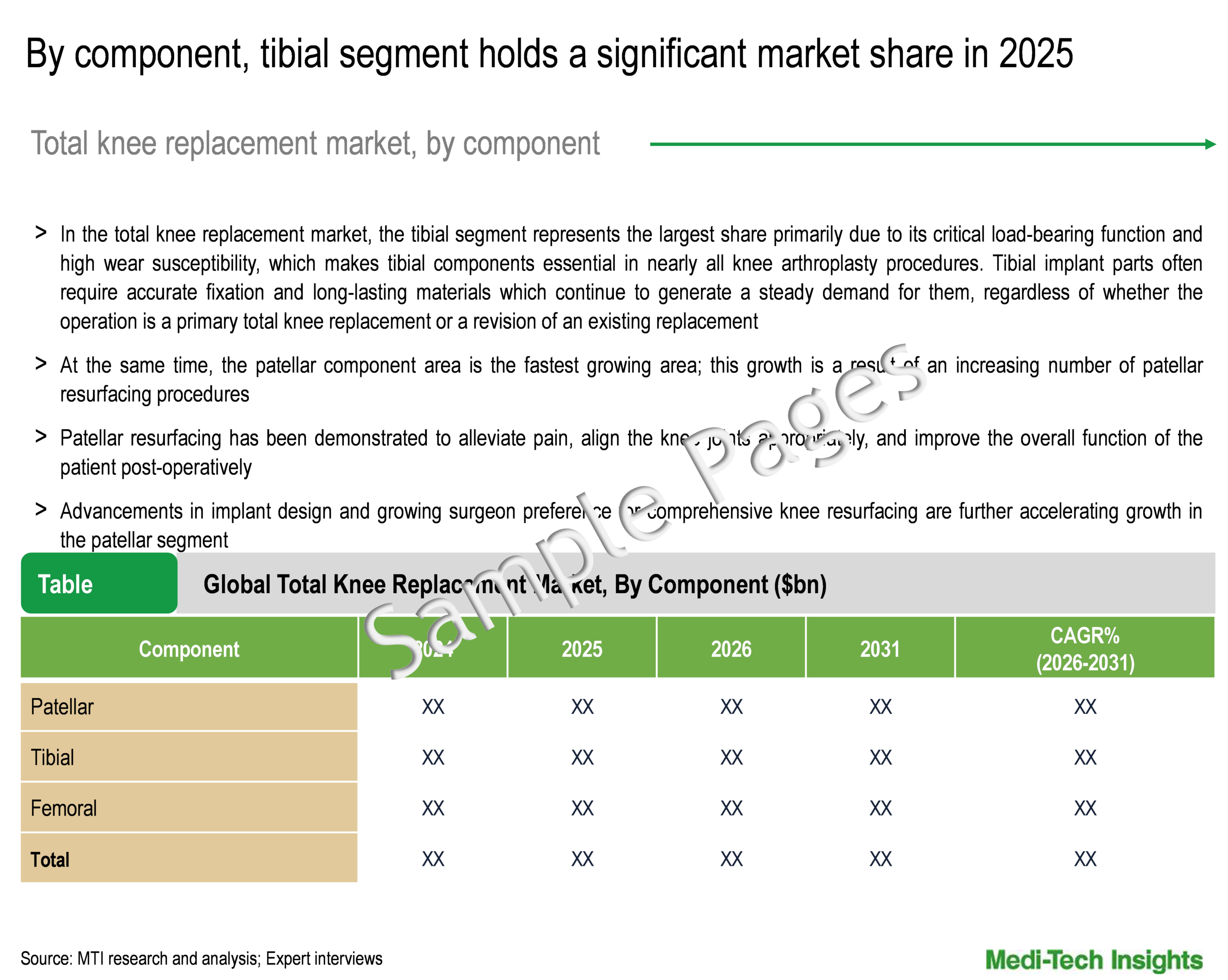
In the total knee replacement market, the tibial segment represents the largest share primarily due to its critical load-bearing function and high wear susceptibility, which makes tibial components essential in nearly all knee arthroplasty procedures. Tibial implant parts often require accurate fixation and long-lasting materials which continue to generate a steady demand for them, regardless of whether the procedure is a primary total knee replacement or a revision of an existing replacement. At the same time, the patellar component area is the fastest growing area; this growth is a result of an increasing number of patellar resurfacing procedures. Patellar resurfacing has been demonstrated to alleviate pain, align the knee joints appropriately, and improve the overall function of the patient post-operatively. Advancements in implant design and growing surgeon preference for comprehensive knee resurfacing are further accelerating growth in the patellar segment.
Regional Outlook: North America expected to hold a major share in the total knee replacement market
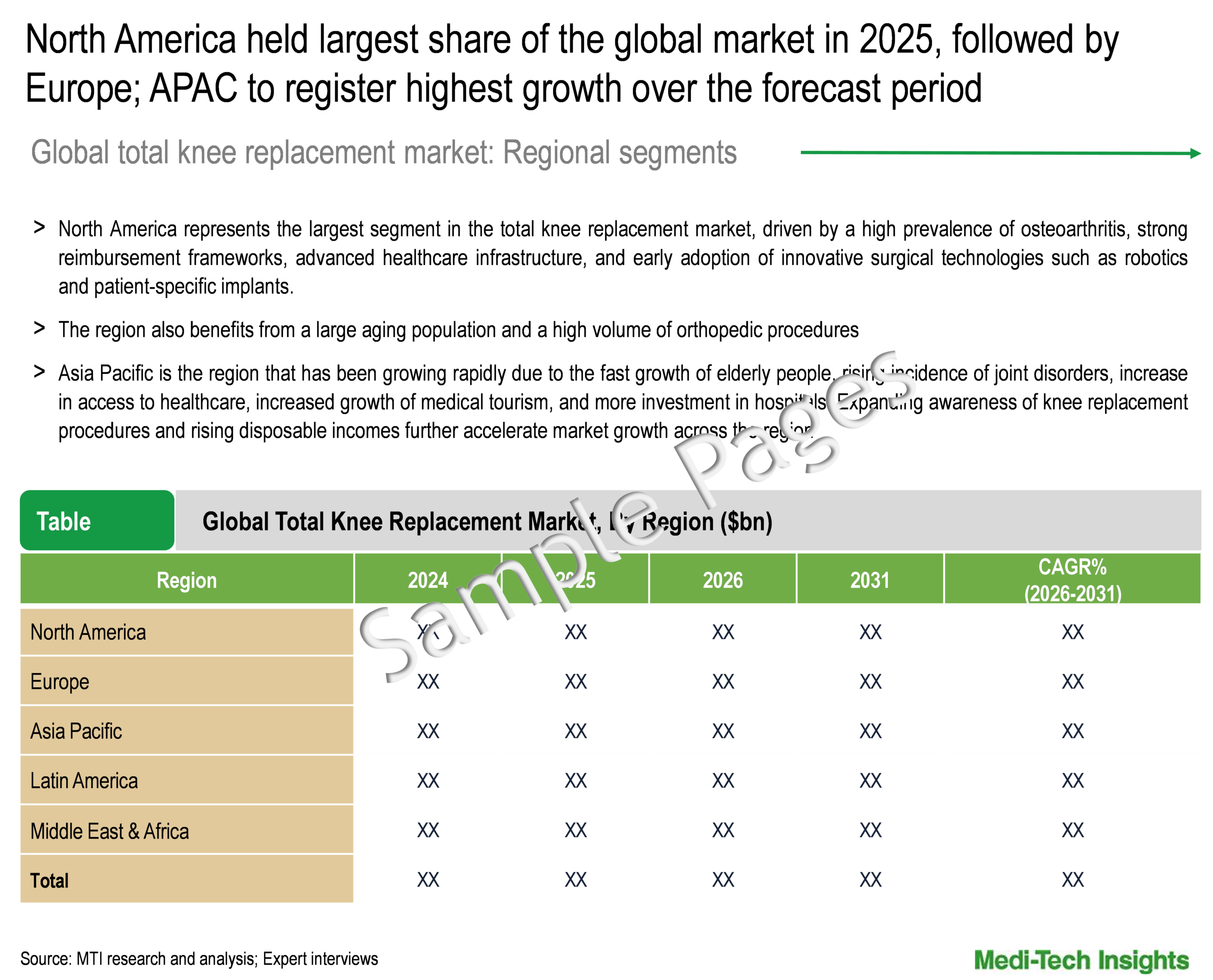
North America represents the largest segment in the total knee replacement market, driven by a high prevalence of osteoarthritis, strong reimbursement frameworks, advanced healthcare infrastructure, and early adoption of innovative surgical technologies such as robotics and patient-specific implants. The region also benefits from a large aging population and a high volume of orthopedic procedures. Asia Pacific is the region that has been growing rapidly due to the rapid growth of elderly population, rising incidence of joint disorders, increase in access to healthcare, increased growth of medical tourism, and growing investment in hospitals. Expanding awareness of knee replacement procedures and rising disposable incomes further accelerate market growth across the region.
Competitive Landscape Analysis
The global total knee replacement market is marked by the presence of established and emerging market players such as Zimmer Biomet (US); Stryker (US); Johnson & Johnson (US); Smith+Nephew (UK); B. Braun SE (Germany); Medacta International (Switzerland); MicroPort Orthopedics, Inc. (US); Exactech, Inc. (US); Corin Group (UK); and Waldemar Link GmbH & Co. KG (Germany); among others. Some of the key strategies adopted by market players include new product launch and approvals, investments, acquisitions, and strategic partnerships and collaborations.

Get a sample report for competitive landscape analysis
Report Scope
|
Report Metric |
Details |
|
Base Year Considered |
2025 |
|
Historical Data |
2024 – 2025 |
|
Forecast Period |
2026 – 2031 |
|
Growth Rate |
5% |
|
Segment Scope |
Product, Device Type, Component, Implant Type, Material, End User |
|
Regional Scope |
|
|
Market Drivers |
|
|
Attractive Opportunities |
|
|
Key Companies Mapped |
Zimmer Biomet (US); Stryker (US); Johnson & Johnson (US); Smith+Nephew (UK); B. Braun SE (Germany); Medacta International (Switzerland); MicroPort Orthopedics, Inc. (US); Exactech, Inc. (US); Corin Group (UK); and Waldemar Link GmbH & Co. KG (Germany); among others |
|
Report Highlights |
Market Size & Forecast, Growth Drivers & Restraints, Trends, Competitive Analysis |
Global Total Knee Replacement Market Segmentation
This report by Medi-Tech Insights provides the size of the global total knee replacement market at the regional- and country-level from 2024 to 2031. The report further segments the market based on product, device type, component, implant type, material, and end user.
Market Size & Forecast (2024-2031), By Product, USD Billion
- Partial Knee Replacement Systems
- Primary Knee Replacement Systems
- Revision Knee Replacement Systems
Market Size & Forecast (2024-2031), By Device Type, USD Billion
- Unicompartmental Knee Implants
- Bi-Compartmental Knee Implants
- Tri-Compartmental Knee Implants
Market Size & Forecast (2024-2031), By Component, USD Billion
- Patellar
- Tibial
- Femoral
Market Size & Forecast (2024-2031), By Implant Type, USD Billion
- Fixed-Bearing Implants
- Mobile-Bearing Implants
- Medial Pivot Implants
- Other Implant Types
Market Size & Forecast (2024-2031), By Material, USD Billion
- Metal-On-Plastic
- Ceramic-On-Plastic
- Metal-On-Metal
- Ceramic-On-Ceramics
Market Size & Forecast (2024-2031), By End User, USD Billion
- Hospitals and Clinics
- Ambulatory Surgery Centers (ASCs)
- Other End Users
Market Size & Forecast (2024-2031), By Region, USD Billion
- North America
- US
- Canada
- Europe
- UK
- Germany
- France
- Italy
- Spain
- Rest of Europe
- Asia Pacific
- China
- India
- Japan
- Rest of Asia Pacific
- Latin America
- Middle East & Africa
- Introduction
- Introduction
- Market Scope
- Market Definition
- Segments Covered
- Regional Segmentation
- Research Timeframe
- Currency Considered
- Study Limitations
- Stakeholders
- List of Abbreviations
- Key Conferences and Events (2026-2027)
- Research Methodology
- Secondary Research
- Primary Research
- Market Estimation
- Bottom-Up Approach
- Top-Down Approach
- Market Forecasting
- Executive Summary
- Total Knee Replacement Market Snapshot (2026-2031)
- Segment Overview
- Regional Snapshot
- Competitive Insights
- Market Overview
- Market Dynamics
- Drivers
- Aging global population and rising osteoarthritis
- Increasing prevalence of degenerative joint diseases
- Lifestyle factors including obesity and sedentary behaviour
- Improved healthcare awareness and access
- Technological advancements
- Restraints
- High procedural and implant costs
- Post-surgical complications
- Insurance reimbursement and coverage issues
- Regulatory hurdles
- Opportunities
- Advanced surgical technologies
- Customized and 3D-printed implants
- Shift to ambulatory and outpatient care
- Emerging healthcare markets
- Tele-rehabilitation and digital health integration
- Key Market Trends
- Robotic-assisted knee replacement
- Digital surgical planning and smart implants
- Minimally invasive techniques
- Unmet Market Needs
- Industry Speaks
- Drivers
- Market Dynamics
- Global Total Knee Replacement Market Size & Forecast (2024-2031), By Product, USD Billion
- Introduction
- Partial Knee Replacement Systems
- Primary Knee Replacement Systems
- Revision Knee Replacement Systems
- Global Total Knee Replacement Market Size & Forecast (2024-2031), By Device Type, USD Billion
- Introduction
- Unicompartmental Knee Implants
- Bi-compartmental Knee Implants
- Tri-compartmental Knee Implants
- Global Total Knee Replacement Market Size & Forecast (2024-2031), By Component, USD Billion
- Introduction
- Patellar
- Tibial
- Femoral
- Global Total Knee Replacement Market Size & Forecast (2024-2031), By Implant Type, USD Billion
- Introduction
- Fixed-Bearing Implants
- Mobile-Bearing Implants
- Medial Pivot Implants
- Other Implant Types
- Global Total Knee Replacement Market Size & Forecast (2024-2031), By Material, USD Billion
- Introduction
- Metal-On-Plastic
- Ceramic-On-Plastic
- Metal-On-Metal
- Ceramic-On-Ceramics
- Global Total Knee Replacement Market Size & Forecast (2024-2031), By End User, USD Billion
- Introduction
- Hospitals and Clinics
- Ambulatory Surgery Centers (ASCs)
- Other End Users
- Global Total Knee Replacement Market Size & Forecast (2024-2031), By Region, USD Billion
- Introduction
- North America Total Knee Replacement Market Size & Forecast (2024-2031), By Country, USD Billion
- US
- Market Size & Forecast, By Product, (USD Billion)
- Market Size & Forecast, By Device Type (USD Billion)
- Market Size & Forecast, By Component (USD Billion)
- Market Size & Forecast, By Implant Type (USD Billion)
- Market Size & Forecast, By Material (USD Billion)
- Market Size & Forecast, By End User (USD Billion)
- Canada
- Market Size & Forecast, By Product, (USD Billion)
- Market Size & Forecast, By Device Type (USD Billion)
- Market Size & Forecast, By Component (USD Billion)
- Market Size & Forecast, By Implant Type (USD Billion)
- Market Size & Forecast, By Material (USD Billion)
- Market Size & Forecast, By End User (USD Billion)
- US
- Europe Total Knee Replacement Market Size & Forecast (2024-2031), By Country, USD Billion
- UK
- Market Size & Forecast, By Product, (USD Billion)
- Market Size & Forecast, By Device Type (USD Billion)
- Market Size & Forecast, By Component (USD Billion)
- Market Size & Forecast, By Implant Type (USD Billion)
- Market Size & Forecast, By Material (USD Billion)
- Market Size & Forecast, By End User (USD Billion)
- Germany
- Market Size & Forecast, By Product, (USD Billion)
- Market Size & Forecast, By Device Type (USD Billion)
- Market Size & Forecast, By Component (USD Billion)
- Market Size & Forecast, By Implant Type (USD Billion)
- Market Size & Forecast, By Material (USD Billion)
- Market Size & Forecast, By End User (USD Billion)
- France
- Market Size & Forecast, By Product, (USD Billion)
- Market Size & Forecast, By Device Type (USD Billion)
- Market Size & Forecast, By Component (USD Billion)
- Market Size & Forecast, By Implant Type (USD Billion)
- Market Size & Forecast, By Material (USD Billion)
- Market Size & Forecast, By End User (USD Billion)
- Italy
- Market Size & Forecast, By Product, (USD Billion)
- Market Size & Forecast, By Device Type (USD Billion)
- Market Size & Forecast, By Component (USD Billion)
- Market Size & Forecast, By Implant Type (USD Billion)
- Market Size & Forecast, By Material (USD Billion)
- Market Size & Forecast, By End User (USD Billion)
- Spain
- Market Size & Forecast, By Product, (USD Billion)
- Market Size & Forecast, By Device Type (USD Billion)
- Market Size & Forecast, By Component (USD Billion)
- Market Size & Forecast, By Implant Type (USD Billion)
- Market Size & Forecast, By Material (USD Billion)
- Market Size & Forecast, By End User (USD Billion)
- Rest of Europe
- Market Size & Forecast, By Product, (USD Billion)
- Market Size & Forecast, By Device Type (USD Billion)
- Market Size & Forecast, By Component (USD Billion)
- Market Size & Forecast, By Implant Type (USD Billion)
- Market Size & Forecast, By Material (USD Billion)
- Market Size & Forecast, By End User (USD Billion)
- UK
- Asia Pacific (APAC) Total Knee Replacement Market Size & Forecast (2024-2031), By Country, USD Billion
- China
- Market Size & Forecast, By Product, (USD Billion)
- Market Size & Forecast, By Device Type (USD Billion)
- Market Size & Forecast, By Component (USD Billion)
- Market Size & Forecast, By Implant Type (USD Billion)
- Market Size & Forecast, By Material (USD Billion)
- Market Size & Forecast, By End User (USD Billion)
- Japan
- Market Size & Forecast, By Product, (USD Billion)
- Market Size & Forecast, By Device Type (USD Billion)
- Market Size & Forecast, By Component (USD Billion)
- Market Size & Forecast, By Implant Type (USD Billion)
- Market Size & Forecast, By Material (USD Billion)
- Market Size & Forecast, By End User (USD Billion)
- India
- Market Size & Forecast, By Product, (USD Billion)
- Market Size & Forecast, By Device Type (USD Billion)
- Market Size & Forecast, By Component (USD Billion)
- Market Size & Forecast, By Implant Type (USD Billion)
- Market Size & Forecast, By Material (USD Billion)
- Market Size & Forecast, By End User (USD Billion)
- Rest of Asia Pacific
- Market Size & Forecast, By Product, (USD Billion)
- Market Size & Forecast, By Device Type (USD Billion)
- Market Size & Forecast, By Component (USD Billion)
- Market Size & Forecast, By Implant Type (USD Billion)
- Market Size & Forecast, By Material (USD Billion)
- Market Size & Forecast, By End User (USD Billion)
- China
- Latin America (LATAM) Total Knee Replacement Market Size & Forecast (2024-2031), USD Billion
- Market Size & Forecast, By Product, (USD Billion)
- Market Size & Forecast, By Device Type (USD Billion)
- Market Size & Forecast, By Component (USD Billion)
- Market Size & Forecast, By Implant Type (USD Billion)
- Market Size & Forecast, By Material (USD Billion)
- Market Size & Forecast, By End User (USD Billion)
- Middle East & Africa (MEA) Total Knee Replacement Market Size & Forecast (2024-2031), USD Billion
- Market Size & Forecast, By Product, (USD Billion)
- Market Size & Forecast, By Device Type (USD Billion)
- Market Size & Forecast, By Component (USD Billion)
- Market Size & Forecast, By Implant Type (USD Billion)
- Market Size & Forecast, By Material (USD Billion)
- Market Size & Forecast, By End User (USD Billion)
- Competitive Landscape
- Key Players and their Competitive Positioning
- Key Player Comparison
- Segment-wise Player Mapping
- Market Share Analysis (2025)
- Company Categorization Matrix
- Dominants/Leaders
- New Entrants
- Emerging Players
- Innovative Players
- Key Strategies Assessment, By Player (2023-2026)
- New Product Launches
- Partnerships, Agreements, & Collaborations
- Mergers & Acquisitions
- Geographic Expansion
- Key Players and their Competitive Positioning
- Company Profiles*
(Business Overview, Financial Performance**, Products Offered, Recent Developments)
- Zimmer Biomet
- Stryker
- Johnson & Johnson
- Smith+Nephew
- Braun SE
- Medacta International
- MicroPort Orthopedics, Inc.
- Exactech, Inc.
- Corin Group
- Waldemar Link GmbH & Co. KG
- Other Prominent Players
The study has been compiled based on extensive primary and secondary research.
Secondary Research (Indicative List)

Primary Research
To validate research findings (market size & forecasts, market segmentation, market dynamics, competitive landscape, key industry trends, etc.), extensive primary interviews were conducted with both supply and demand-side stakeholders.
Supply Side Stakeholders:
- Senior Management Level: CEOs, Presidents, Vice-Presidents, Directors, Chief Technology Officers, Chief Commercial Officers
- Mid-Management Level: Product Managers, Sales Managers, Brand Managers, R&D Managers, Business Development Managers, Consultants
Demand Side Stakeholders:
- Hospitals and Clinics, Ambulatory Surgery Centers (ASCs), and others
Breakdown of Primary Interviews

Market Size Estimation
Both ‘Top-Down & Bottom-Up Approaches’ were used to derive market size estimates and forecasts
Data Triangulation
Research findings derived through secondary sources & internal analysis was validated with Primary Interviews, Internal Knowledge Repository and Company’s Sales Data

Features of the Report
- Comprehensive Market Coverage
- Market Size and Forecast
- Geographic & Segment Deep Dives
- Strategic Insights & Competitive Landscape
- Timely & Updated Data
- Growth Indicators & Future Outlook
- Quick Turnaround on Queries
- Analyst Support
- Report Customization Available
- Reports in PDF & Excel
