Download FREE Sample


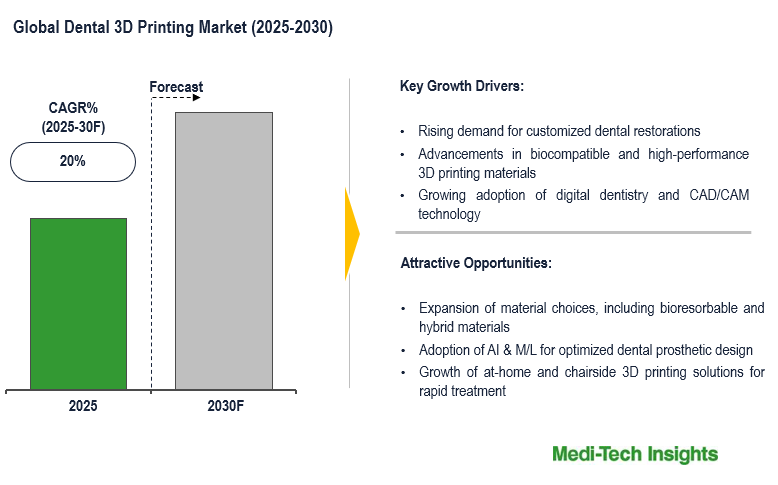
The dental 3D printing market is experiencing significant growth, with a projected CAGR of around 20% during the forecast period. Factors such as increasing demand for customized dental solutions, advancements in biocompatible materials, and the growing adoption of digital dentistry are driving market expansion. However, high initial investment costs, regulatory complexities, and material limitations pose challenges to widespread adoption. To learn more about the research report, download a sample report.
Report Overview
Dental 3D printing is a digital manufacturing process that enables the production of dental restorations, prosthetics, and orthodontic models with high precision. This technology utilizes materials such as resins, ceramics, and metal alloys to create customized dental implants, crowns, dentures, and surgical guides. The process enhances efficiency, reduces material wastage, and enables same-day dental solutions. With digital workflows becoming standard in modern dentistry, 3D printing plays a crucial role in revolutionizing patient-specific treatments.
To learn more about this report, download the PDF brochure
Rising demand for customized dental restorations
The increasing demand for personalized dental restorations is the most significant factor driving the growth of the dental 3D printing market. Traditional dental restoration methods are time-consuming and often result in multiple visits to the dentist, leading to inconvenience for patients. In contrast, 3D printing allows the rapid production of crowns, bridges, and dentures tailored to an individuals oral structure, ensuring a perfect fit and enhanced aesthetics. Additionally, digital scanning and CAD/CAM technologies enable precise design modifications, reducing errors and improving patient outcomes. The ability to fabricate complex dental structures with minimal material waste also makes 3D printing a cost-effective solution in the long run. As more dental clinics and laboratories integrate this technology into their workflow, the demand for efficient and high-quality restorations continues to propel market growth.
Advancements in multi-material and full-color 3D printing
Another major trend shaping the dental 3D printing market is the advancement in multi-material and full-color printing technologies. Traditionally, dental 3D printing was limited to single-material fabrication, often requiring post-processing steps to achieve the desired strength, flexibility, or aesthetics. However, recent innovations now allow the simultaneous printing of multiple materials in a single build, enabling the creation of dental restorations that closely mimic natural tooth properties in terms of translucency, color gradients, and mechanical strength. Full-color 3D printing has also gained traction, particularly in orthodontics and prosthodontics, where lifelike models, crowns, and dentures can be produced without the need for manual coloring. This advancement not only enhances the accuracy and realism of dental prosthetics but also reduces labour-intensive finishing processes. With these innovations, dental professionals can offer highly customized and aesthetic solutions to patients while improving efficiency and reducing production time, further driving market adoption.
To learn more about this report, download the PDF brochure
Competitive Landscape Analysis
The global dental 3D printing market is marked by the presence of established and emerging market players such 3D Systems, Stratasys Ltd, Form Labs, Roland DG Corporation, 3Shape, EnvisionTEC, Renishaw, Dentsply Sirona, Inc., Prodways Group, and Micron Dental among others. Some of the key strategies adopted by market players include new product development, strategic partnerships and collaborations, and geographic expansion.
Report Scope
| Report Metric | Details |
| Base Year Considered | 2024 |
| Historical Data | 2023 - 2024 |
| Forecast Period | 2025 2030 |
| Growth Rate | 20% |
| Market Drivers |
|
| Attractive Opportunities |
|
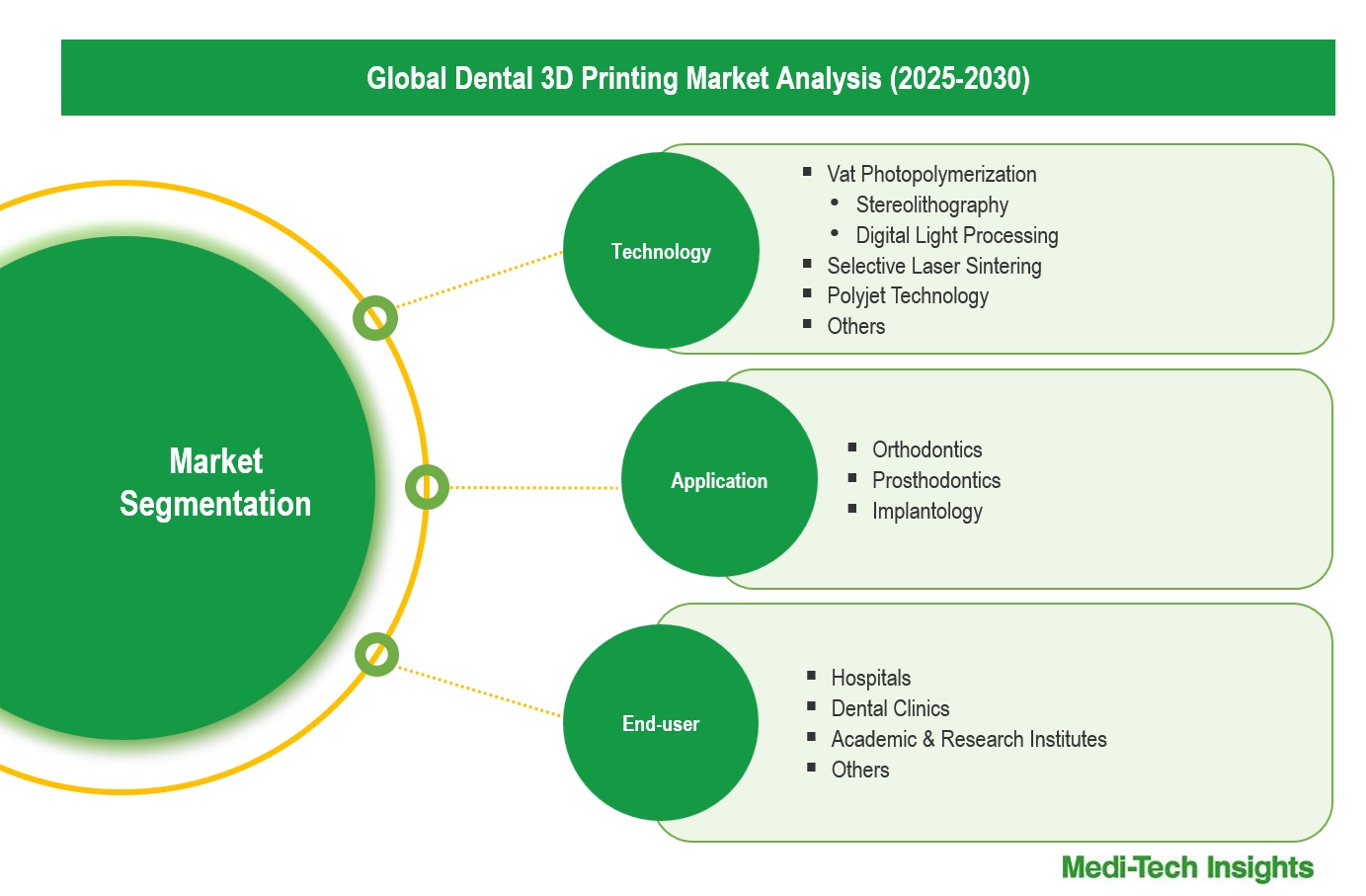
| Segment Scope | Technology, Application, and End-user |
| Regional Scope |
|
| Key Companies Mapped | 3D Systems, Stratasys Ltd, Form Labs, Roland DG Corporation, 3Shape, EnvisionTEC, Renishaw, Dentsply Sirona, Inc., Prodways Group, and Micron Dental among others |
| Report Highlights | Market Size & Forecast, Growth Drivers & Restraints, Trends, Competitive Analysis |
Global Dental 3D Printing Market Segmentation
This report by Medi-Tech Insights provides thesize of the global dental 3D printing market at theregional- and country-level from 2023 to 2030. The report further segments the market based on technology, application, and end-user.
Market Size & Forecast (2023-2030), By Technology, USD Million
- Vat Photopolymerization
- Stereolithography
- Digital Light Processing
- Selective Laser Sintering
- Polyjet Technology
- Fused Deposition Modelling
- Others
Market Size & Forecast (2023-2030), By Application, USD Million
- Orthodontics
- Prosthodontics
- Implantology
Market Size & Forecast (2023-2030), By End-user, USD Million
- Hospitals
- Academic & Research Institutes
- Others
Market Size & Forecast (2023-2030), By Region, USD Million
- North America
- US
- Canada
- Europe
- UK
- Germany
- France
- Italy
- Spain
- Rest of Europe
- Asia Pacific
- China
- India
- Japan
- Rest of Asia Pacific
- Latin America
- Middle East & Africa
Key Strategic Questions Addressed
- What is the market size & forecast of the dental 3D printing market?
- What are historical, present, and forecasted market shares and growth rates of various segments and sub-segments of the dental 3D printing market?
- What are the key trends defining the market?
- What are the major factors impacting the market?
- What are the opportunities prevailing in the market?
- Which region has the highest share in the global market? Which region is expected to witness the highest growth rate in the next 5 years?
- Who are the major players operating in the market?
- What are the key strategies adopted by players?
Need a More Tailored Analysis?
- Discuss the market sizing methodology and forecast assumptions with our healthcare analysts.
- Expand the scope with additional countries, market segments, technologies, or competitor profiling.
- Use the insights to support strategic planning, market entry, commercial due diligence, and long-term revenue growth initiatives.